







Russia’s Secret Drone Bases Now Put NATO Within Strike Range

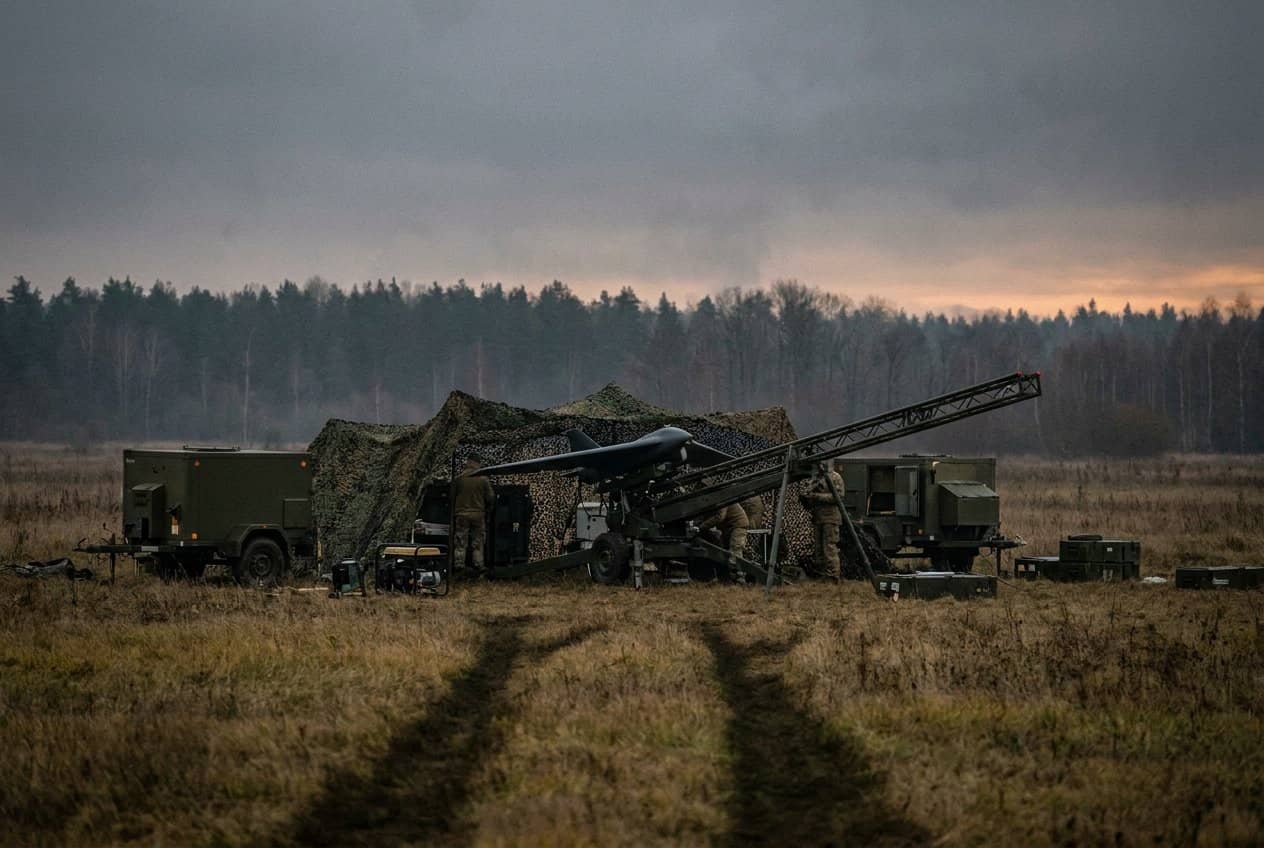
Russia has quietly built a network of drone-launching facilities along its western frontier that puts several NATO member states within range of its newest long-range strike drones, according to an investigation that has rattled European capitals this week.
A Telegraph investigation published Aug. 16 identified 10 Kremlin bases with newly built launch pads for what the paper described as Moscow's most advanced long-range suicide drones. Using satellite imagery and leaked documents, reporters traced at least 59 newly constructed launch rails — fixed mechanical tracks that let jet-powered drones take off without a conventional runway — spread across the 10 sites along Russia's borders with Ukraine and Belarus.
The find was independently corroborated within a day by outlets including the Kyiv Independent, Newsweek, and Turkish outlet Türkiye Today, all of which reviewed the Telegraph's findings and added their own reporting. The Telegraph's own account confirmed the story on its official X feed, where the paper wrote that the bases were "capable of firing high-powered drones deep into Nato territory."
Russia has installed secret bases capable of firing high-powered drones deep into Nato territory.
— The Telegraph (@Telegraph) August 16, 2026
A Telegraph investigation can reveal 10 Kremlin bases with newly built launch pads for Moscow’s most advanced long-range suicide drones.
🔗 https://t.co/SEFQQTn385 pic.twitter.com/VgBiT9P4MH
Some of the launch sites were repurposed from old military bases and civilian airports, while others were carved out of open countryside. One base alone has storage capacity for more than 1,000 drones at a time, and construction of additional launch rails is reportedly underway at several key locations.
The infrastructure is built to accommodate Russia's newest strike drones, the Geran-4 and Geran-5, jet-powered variants of the Iranian-designed Shahed that can fly nearly 1,000 kilometers (620 miles) while carrying a 90-kilogram warhead. Unlike the slower, propeller-driven Shaheds that have dominated headlines since 2022, the jet variants fly fast enough to strain existing air-defense intercept timelines.
Analysis firm DroneSec examined the satellite imagery for the Telegraph and found that roughly 20 of the newly built launch rails were extended in length — consistent with the dimensions needed to fire the longer-range Geran-4/5 variants. DroneSec CEO Mike Monnik said the expansion reflects a dual purpose: sustaining the tempo of attacks on Ukraine while holding NATO states "at risk of such attacks." He added that the combination of higher drone volume and reduced interceptability "increase[s] the difficulty facing Ukrainian forces in intercepting newer Russian drone designs."
Ukraine's GUR military intelligence agency has separately warned that Russia is working to arm Geran-family drones with air-to-air missiles, aimed at Ukrainian aircraft defending Kyiv's airspace. Newsweek reported that Ukrainian industry sources put Russian output of the upgraded Geran-4/5 models at roughly 3,000 units a month, largely from the Alabuga special economic zone in Tatarstan.
This isn't a hypothetical buildup. Open-source flight-tracking data showed seven of the 10 identified bases were used in Russia's recent bombardments of Kyiv. The timing lines up with a documented surge in jet-powered drone use: Ukraine's Air Force told the Kyiv Independent that jet-drone strikes rose fivefold in July compared with June, as Kyiv's air defenses strain under a shortage of Patriot interceptor missiles. A July 2 attack on Kyiv killed at least 31 people, and a follow-on strike four days later killed at least 26 more — context that underscores why analysts are treating the new launch infrastructure as an operational threat rather than a symbolic one.
The NATO-facing angle is what elevates this from a Ukraine story to a SOF and Article 5 planning concern. Some of the mapped launch sites — including facilities identified by the Telegraph near Shatalovo, Millerovo, and Primorsko-Akhtarsk — sit close enough to the border that Geran-5 range rings would cover Poland, the Baltic states, Romania, and parts of Turkey, and put Warsaw within reach if drones were launched from western-most sites. A NATO official told the Telegraph the alliance is "ready to defend every inch of allied territory" and is working to "enhance our readiness to deter and defend against any threat, including from drones."
That reassurance comes against a backdrop of genuine alarm inside the alliance. Newsweek reported that U.S. intelligence assessments cited by the Wall Street Journal put Russia on a timeline where it could attempt a limited probing operation or intensified hybrid attack against a NATO member as early as this September. Germany's top general has separately said Moscow is using drone incursions to study how NATO air defenses react — a pattern consistent with at least 20 drones crossing into Poland in September 2025 and a Russian cruise missile crashing in eastern Poland last month.