







Pentagon Weighs Cutting 40,000 US Troops From Europe soon

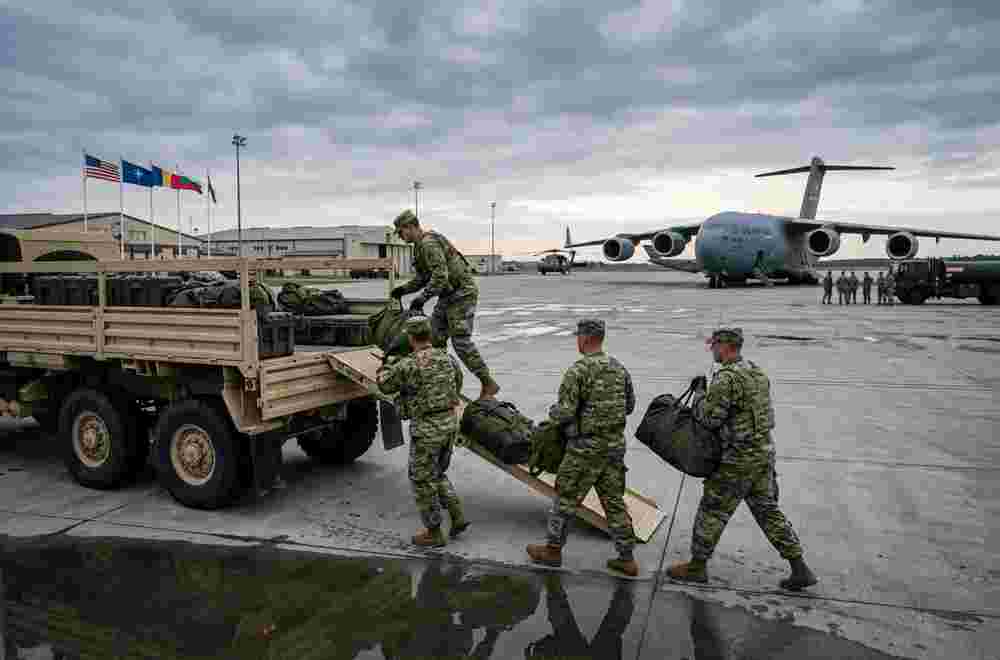
The Pentagon's review of America's military footprint in Europe crossed a significant threshold this week, as the officer who leads U.S. forces on the continent delivered his initial read on options that could reshape NATO's eastern and western flanks alike. For a force posture that has defined the alliance since the Cold War, the stakes of this internal Pentagon exercise are difficult to overstate.
On September 18, NATO's supreme allied commander, U.S. Air Force Gen. Alexus Grynkewich, took part in a virtual briefing with Pentagon policy chief Elbridge Colby to talk through potential approaches to the ongoing review of U.S. troop deployments in Europe, according to Reuters. A NATO spokesperson framed Grynkewich's participation as part of Europe "continuing to take more and more responsibility for its defense" as the alliance transitions toward what officials are calling "NATO 3.0." The briefing was a working session, not a final decision point, but it fed directly into the options Defense Secretary Pete Hegseth is expected to receive.
That timeline traces back to an internal Pentagon document, its "Terms of Reference," obtained by Reuters in late August. The document lays out a plan for at least 25,000 troops, and possibly as many as 40,000 to be cut from the roughly 80,000 U.S. forces currently stationed across Europe, with a formal recommendation due to Hegseth by November 6, ahead of a December deadline for the broader review Hegseth announced in June. The review will generate at least four distinct options rather than a single plan, the document shows, and will weigh not just troop numbers but access, basing, overflight rights, and allied contributions to space, cyber, and intelligence infrastructure.
Germany, Italy, and Spain, which host some of the largest American troop concentrations in Europe, are likely to see the deepest reductions, NBC News has reported [3], since a cut of that scale would reduce U.S. presence there by nearly a third and, under some options, by roughly half. Romania offers an early preview of what a drawdown looks like in practice: about half of the roughly 2,000 American troops posted there have already departed as part of an earlier realignment, alarming a NATO frontline state that borders Ukraine at a moment when Russian drones have repeatedly crossed into allied airspace, according to the Japan Times.
The review is running into resistance on Capitol Hill. Senate Armed Services Chair Roger Wicker said earlier this year he was "not at all happy about" the troop moves, and House Armed Services Chair Mike Rogers has warned the department against breaking a statutory floor Congress wrote into the 2026 defense authorization law, which bars reducing U.S. forces in Europe below 76,000 without first delivering a security assessment and certification to lawmakers. Not every Republican agrees with that guardrail: Sen. Eric Schmitt has called it an overreach of Congress's role and said he would "vehemently oppose" similar restrictions in future legislation, while Sen. Kevin Cramer has demanded Colby appear before the Armed Services Committee to explain the administration's thinking directly.
This is not the first time Hegseth's ambitions for a larger European drawdown have collided with resistance inside his own administration. The Wall Street Journal reported that Hegseth had planned to tell NATO defense ministers in June that the Pentagon was preparing a fresh round of cuts, on top of an already-canceled armored brigade rotation to Poland and a withdrawal from Romania, but the plan was shelved after he ran it past Secretary of State Marco Rubio and other senior officials at the White House. Instead of announcing new cuts, Hegseth unveiled the six-month review that is now nearing its conclusion. Pentagon chief spokesman Sean Parnell said at the time that Hegseth "ensured his message was aligned with the president's objectives" and did not want to "impede upon the president's decision space" — an unusually candid acknowledgment of internal friction over the pace of change.
Colby, for his part, has been public and direct about the review's purpose. "This will be a real review, designed to ensure that NATO is moving fast and irreversibly toward Europe taking primary responsibility for its conventional defense," he wrote when the process formally began, adding that any resulting posture would be grounded in "strategic rigor" and "a clear sense of the geopolitical and military realities."
Today, the Department of War kicked off the Europe Posture Review Secretary Hegseth announced at the last NATO Defense Ministerial Meeting in Brussels. As the Secretary laid out then, this will be a real review, designed to ensure that NATO is moving fast and irreversibly toward…
— Under Secretary of War Elbridge Colby (@USWPColby) July 28, 2026
The administration's basic logic is not in dispute: even skeptics like Wicker and Rogers back the underlying push for allies to shoulder more conventional defense spending. What divides Washington is sequencing and signaling. Pulling forces before European militaries can backfill the gap risks the outcome hawks fear most — a perception of American retreat just as Russian drone incursions into Poland and Romania have already tested NATO's eastern edge. That risk calculus helps explain a parallel trend the Japan Times has tracked this year: at least eight NATO members, including Canada, Poland, Denmark, and Spain, are diversifying procurement away from American systems toward alternatives like Germany's IRIS-T and the French-Italian SAMP/T, partly to insulate their arsenals from this kind of policy volatility. An administration pressure campaign meant to make allies more capable and more American-aligned may instead be accelerating European strategic autonomy — a slower but longer-lasting shift than any single round of troop cuts.
For now, no final decision has been made. Hegseth's recommendation to President Trump is still seven weeks away, and the four-option framework built into the review process suggests the administration itself has not settled on a number. What is clear is that the scale under discussion — up to half the U.S. presence in the alliance's most exposed member states — would mark the most significant reshaping of American force posture in Europe since the drawdowns that followed the Cold War, whatever number Hegseth ultimately puts in front of the president.