







US Intel Warns Russia Could Test NATO With Attacks This Fall

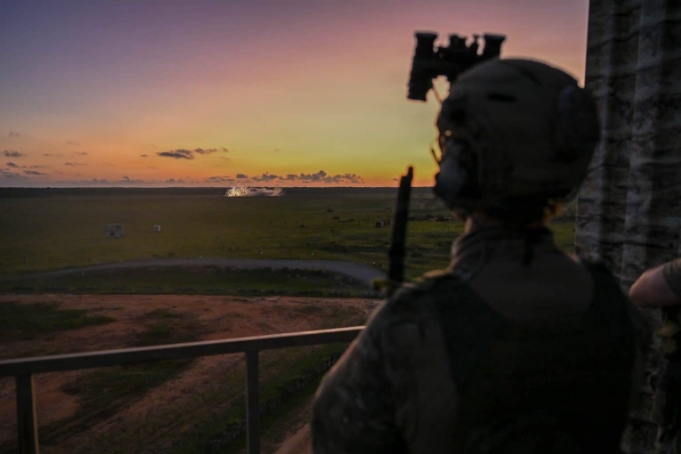
A Czech special operations forces member observes an AC-130J Ghostrider gunship strike during Emerald Warrior Spiral on Eglin Range, Florida, on June 11, 2026. (Credit: U.S. Air Force photo by Airman 1st Class Aidan Stein)
U.S. intelligence has concluded that Russian President Vladimir Putin could probe NATO’s resolve with a limited military strike on an allied country at any point between this fall and 2029, The Wall Street Journal reported on Aug. 6, citing new intelligence assessments described by U.S. officials.
The assessment departs significantly from Washington’s prior position, which held that Moscow was unlikely to provoke a direct confrontation with the alliance while fighting in Ukraine.
The intelligence reports outline a range of possible Russian actions, from cyberattacks and the deployment of unmarked armed groups to a small-scale land incursion along NATO’s eastern flank. U.S. officials framed the scenarios as deliberate probes intended to fracture the 77-year-old alliance and test Washington’s commitment to collective defense under Article 5.
Officials pointed to actions Russia has already taken as possible early tests of NATO’s response. A Russian cruise missile landed on Polish territory earlier this year, and a Russian drone struck an apartment building in western Romania in May.
An explosive drone was also found at Leipzig/Halle Airport in Germany in recent days, with its suspected target a Ukrainian cargo aircraft carrying weapons.
The shift in the U.S. assessment reflects mounting pressure on Putin to deliver a decisive outcome in Ukraine as the war enters its fifth year, combined with an acute shortfall in Western munitions stockpiles. U.S. officials told the Journal the inventory gaps extend to the critical munitions Washington would need to respond to a Russian or Chinese attack
Russia has also simultaneously accelerated military buildup along NATO’s borders. A joint investigation by Scandinavian and Baltic media outlets published in June found that Moscow is constructing infrastructure which would be capable of accommodating up to 115,000 troops near the borders of Norway, Finland, the Baltic states, and in the Kaliningrad exclave.
The new U.S. assessment aligns with warnings European military leaders have been issuing in recent months. In June, German Army Chief Lt. Gen. Christian Freuding told Politico that 2029 is “not a German timeline – it’s NATO-agreed intelligence,” noting that all 32 alliance members have reached consensus that Russia could have the capability to invade a NATO partner country by that date.
A limited Russian action against a NATO member would trigger consideration of Article 5, the alliance’s collective defense clause, but the ambiguity inherent in hybrid or deniable operations is itself part of the strategic logic.
U.S. officials have not publicly disclosed which member states are assessed as the most probable targets, but NATO’s eastern flank has historically concentrated the highest level of concern.
The concern for NATO extends beyond the possibility of a conventional military attack. Russian cyber operations, sabotage, disinformation campaigns and other forms of hybrid warfare could provide Moscow with opportunities to test alliance cohesion while maintaining plausible deniability. Such actions could make it difficult for NATO governments to determine whether an incident represents an isolated event or part of a broader more in-depth Russian strategy.
For Washington and its European allies, the challenge would be determining how to respond without allowing a limited confrontation to escalate into a wider conflict. A carefully thought out and calibrated Russian operation could be designed to exploit political divisions within NATO, particularly if some members hesitate to support a forceful response. The effectiveness of such a strategy would ultimately depend not only on Russia’s military capabilities, but also on whether NATO members demonstrate a unified willingness to defend the alliance’s eastern flank.