








Russia Warns of Nuclear Response to Any Kaliningrad Blockade

Russia has told NATO it is ready to use nuclear weapons if the alliance tries to cut off Kaliningrad, its heavily militarized exclave on the Baltic Sea. The warning came in a diplomatic memo asserting that NATO is preparing "an air and naval blockade", and it arrived on Sept. 29-30, just before Vladimir Putin repeated the threat in public. NATO says it is a purely defensive alliance, and none of the reporting reviewed for this piece shows evidence of any such blockade plan. What the episode does show is how fast a Baltic geography problem can turn into nuclear signaling.
According to the Kyiv Independent, the note says Russia "will be ready to use the entire arsenal of forces and capabilities at its disposal, including nuclear weapons" to defend its territory if NATO members try to isolate Kaliningrad. It also reportedly warns of strikes against "decision-making centers" in alliance states from the outset of any conflict. Foreign Minister Sergey Lavrov separately said that if the West attacked Russia, Moscow would answer with "a completely different war and a very brief one."
A parallel statement came from the Russian Embassy in Ireland, which TASS dated Sept. 29 and which Russian outlets framed as a response to supposed NATO blockade preparations. Other reporting says embassies in at least three European countries issued similar messages, including Belgium's. Outlets disagree on timing: the Kyiv Independent places the Irish embassy statement on Sept. 30, TASS on Sept. 29.
Moscow's own messaging has been mixed. Kremlin spokesman Dmitry Peskov said Russia "has no intention to use nuclear weapons," according to TASS, while Fox News and others report he described the warnings as reminders for "hotheads in Europe".
NATO Secretary-General Mark Rutte answered at the Euronews Defence & Space Summit in Brussels on Sept. 30, saying NATO is defensive, telling Moscow to "stop the nuclear threats," and arguing Putin "can never win" in a direct escalation with the alliance. Quotes of his dismissiveness vary by outlet: United24 Media renders it as "I don't take this that serious", while Euronews' account has him saying he does not take it seriously. NATO spokesperson Allison Hart separately condemned the threat of force and what she called irresponsible nuclear rhetoric.
In Vilnius, Deividas Matulionis, national security adviser to President Gitanas Nausėda, called the Russian claims "completely baseless" and a form of psychological pressure on September 29. Lithuanian reporting notes this is not the first time this year Moscow has made such accusations.
On Oct. 1, Putin addressed the Valdai Forum in Moscow and said that in the event of a direct attack on Russia, "in this case, we are referring to Kaliningrad," the question of using "all the weapons at our country's disposal" would "inevitably and immediately be on the agenda." One precision matters here: the quoted words as reported do not themselves say "nuclear," though headlines and Western officials read them that way, and Putin has paired such language with an admission that France and Britain are nuclear powers and a warning that escalation could reach "a fatal point of no return".
Not every Baltic official is alarmed by the nuclear language. Latvian Defense Minister Raivis Melnis told RFE/RL he saw no imminent danger, saying "I don't see an imminent threat at this point" and arguing that hybrid activity such as cyberattacks, suspected sabotage, migration pressure from Belarus and drone incursions is the more pressing danger.
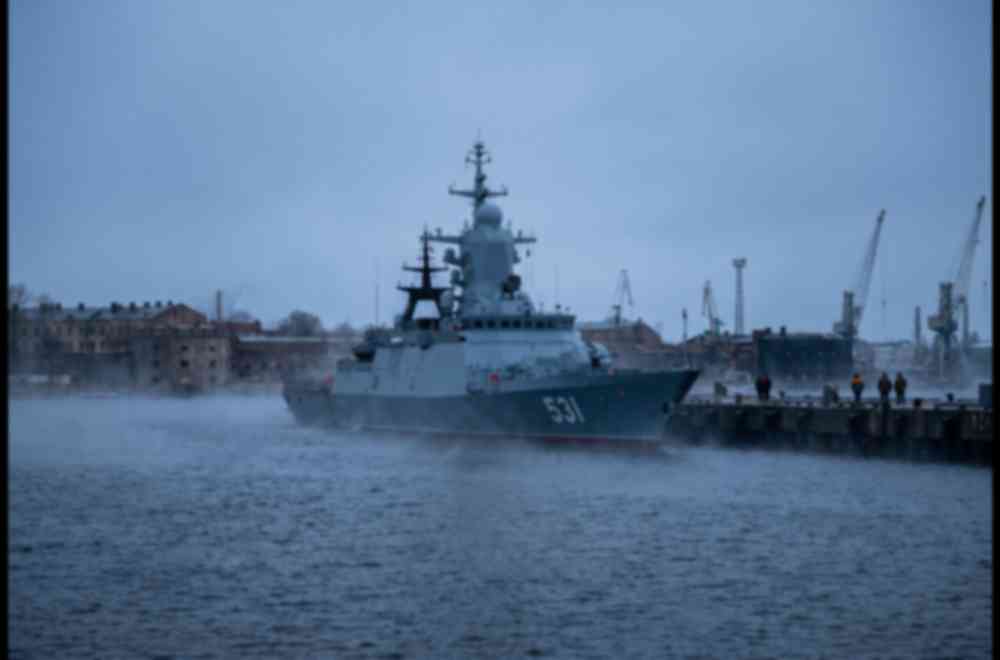
Kaliningrad is a sliver of former East Prussia that the Soviet Union took after World War II. It sits between NATO members Poland and Lithuania, separated from mainland Russia by Lithuania and Belarus, and covers about 15,000 square kilometers with roughly one million residents. It hosts elements of Russia's Baltic Fleet and missile systems Al Jazeera describes as nuclear-ready Iskanders. Just to its southeast, the roughly 104-kilometer Suwalki Gap is the only land corridor linking the Baltic states to the rest of NATO, which is why any Kaliningrad crisis is also a Baltic reinforcement problem.
The backdrop is a hardening one. A large NATO air package, including U.S. and Norwegian fighters, an E-3A AWACS and a U.S. EA-37B electronic warfare aircraft, operated near Kaliningrad during an Aug. 18-19 air exercise. Stars and Stripes reported that officials framed it as deterrence, and that Russia did not respond directly. SOFX cited a 25-to-50 aircraft figure, but Stripes described that range as unverified because officials withheld the numbers. Allied rhetoric has also been pointed: in July 2025, U.S. Army Europe commander Gen. Chris Donahue suggested allied forces could take Kaliningrad down "in a timeframe that is unheard of", a remark that drew a nuclear-retaliation warning from Russian lawmaker Leonid Slutsky.
Russia has now put its nuclear option on the record over Kaliningrad twice in 48 hours, once through diplomatic channels and once through Putin. NATO has refused to be baited, and the Baltic states are watching hybrid threats more than missiles. The next test is practical: whether upcoming allied drills near the exclave are met with more notes or something harder to dismiss.