






What to Put in an IFAK: Complete Contents Checklist

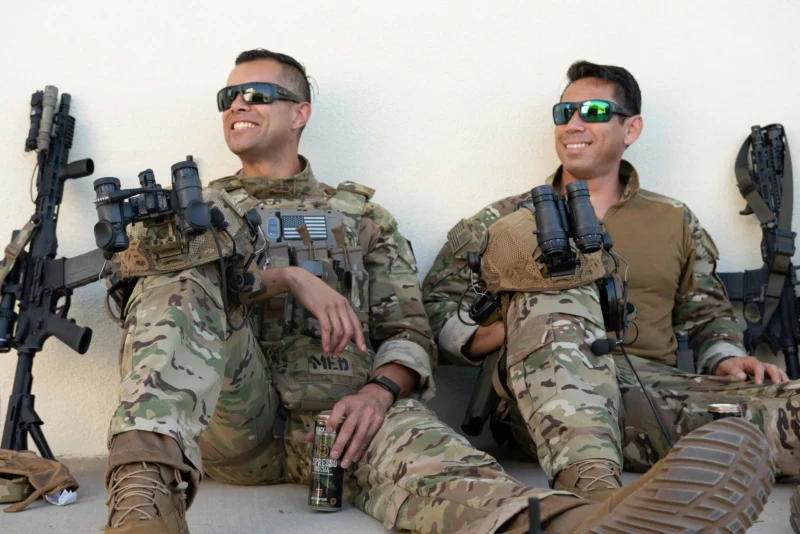
An Individual First Aid Kit, commonly known as an IFAK, is a compact trauma kit designed to be carried on your body and used to treat life-threatening injuries in the field before professional medical help arrives. Unlike a standard first aid kit found in an office breakroom, an IFAK is built around one priority: stopping preventable death from traumatic injury in the critical minutes after an incident occurs.
Whether you are a law enforcement officer, a soldier, a security professional, a hunter, or a prepared civilian, having a properly stocked IFAK and knowing how to use it can be the difference between survival and a preventable loss. This guide is a complete IFAK contents checklist covering what should go in your kit, how to organize it, and how to carry it for fast access when it matters most.
What Is an IFAK and Why Do You Need One?
The IFAK originated in the U.S. military as a standardized kit issued to every soldier for self-treatment and buddy aid in combat. The concept has since been adopted by law enforcement, first responders, and civilian preparedness communities because the injuries an IFAK addresses, such as arterial bleeding, penetrating chest wounds, and airway obstruction, can occur in any environment, not just on a battlefield.
Research from the Journal of Special Operations Medicine consistently shows that the majority of preventable deaths in trauma situations result from uncontrolled hemorrhage. An IFAK, stocked with the right tools and used within the first few minutes after injury, gives a casualty a dramatically better chance of survival. Professional medical training, such as a Tactical Combat Casualty Care (TCCC) or Stop the Bleed course, should accompany any IFAK purchase.
The MARCH Protocol: The Framework Behind Every IFAK
Before listing the contents, it helps to understand the MARCH protocol, the standard used by military medics and tactical first responders to prioritize treatment. MARCH stands for Massive Hemorrhage, Airway, Respiration, Circulation, and Hypothermia. Every item in a well-built IFAK maps to one of these five priorities. When you understand the framework, every item makes sense.
Core IFAK Contents: What Every Kit Must Have
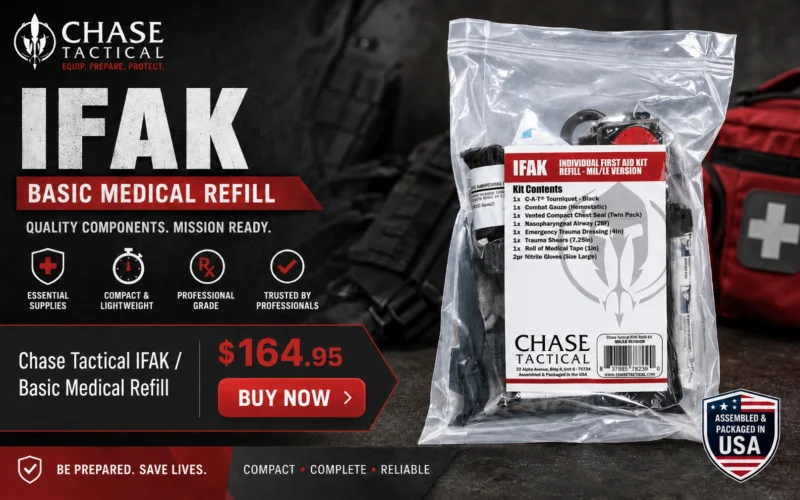
The following IFAK contents checklist represents the minimum required items for any kit intended for trauma response. These are not optional additions but foundational tools for addressing the most common causes of preventable death in trauma situations.
1. Tourniquet
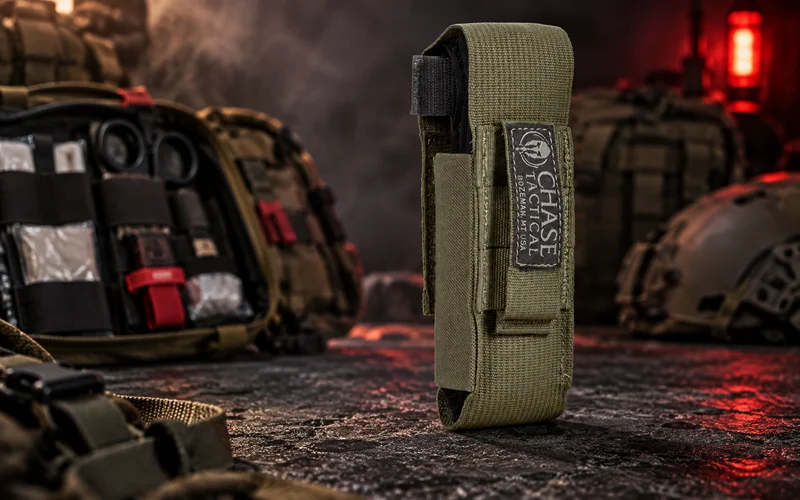
A tourniquet is the single most critical item in any IFAK. Applied correctly within the first few minutes of a severe extremity injury, a tourniquet stops arterial bleeding and keeps a casualty alive long enough to reach definitive care. Use a windlass-style tourniquet, such as the Combat Application Tourniquet (CAT), that can be applied quickly with one hand.
Always carry at least one tourniquet on the outside of your kit where it can be grabbed immediately without opening a pouch. For a closer look at tourniquet types and how to choose one, see our full tourniquet guide.
2. Pressure Bandage or Emergency Trauma Dressing
A pressure bandage is used to treat wounds that a tourniquet cannot address, such as injuries to the torso, neck, or groin. It applies continuous pressure directly to the wound site to slow or stop bleeding. Israeli-style bandages and similar emergency trauma dressings are compact and easy to apply under stress.
3. Hemostatic Gauze
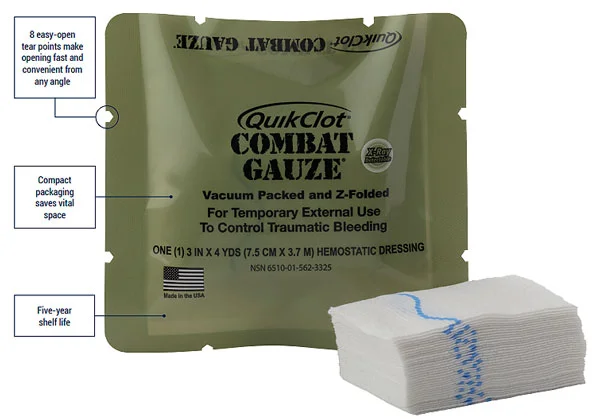
Hemostatic gauze is chemically treated gauze designed to accelerate clotting for wounds that cannot be tourniqueted. It is used to pack wounds in junctional areas like the groin, armpit, and neck where tourniquet application is not possible. Packing a wound with hemostatic gauze and applying firm pressure are among the most effective techniques for controlling life-threatening hemorrhage in these areas.
4. Chest Seals (Vented)
A penetrating chest wound creates a sucking chest wound that collapses the lung and rapidly becomes fatal if untreated. Vented chest seals allow air to escape while preventing air from entering the pleural cavity. Carry two chest seals for each casualty, one for the entry wound and one for the exit wound.
5. Nasopharyngeal Airway (NPA) with Lubricant
An NPA is a flexible tube inserted through the nose to maintain a clear airway in an unconscious or semi-conscious casualty. It is one of the most effective and easiest airway management tools to use in a non-clinical environment. Always store it with the recommended lubricant for fast, safe insertion.
6. Trauma Shears
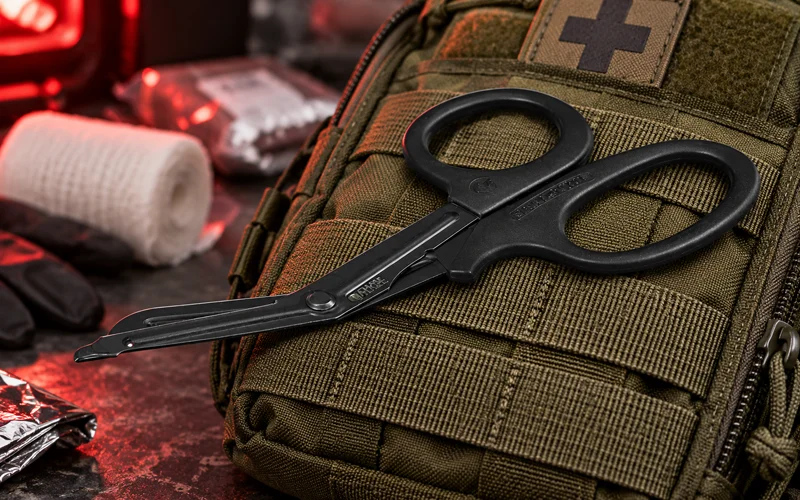
Trauma shears are heavy-duty scissors designed to cut through clothing, gear, belts, and webbing rapidly to expose wounds for treatment. They should be accessible without opening the main compartment of your kit. Quality trauma shears are an essential and often overlooked part of every kit.
7. Nitrile Gloves
Gloves protect you from bloodborne pathogens during treatment. Pack at least two pairs in your IFAK and store them in an accessible outer pocket. Choose nitrile over latex to avoid allergic reactions.
8. Permanent Marker
When a tourniquet is applied, write the time of application on the casualty’s forehead or forearm in permanent marker. This information is critical for medical personnel upon handoff. A simple Sharpie tucked inside your kit can save a life.
Secondary Items Worth Adding to a Larger IFAK
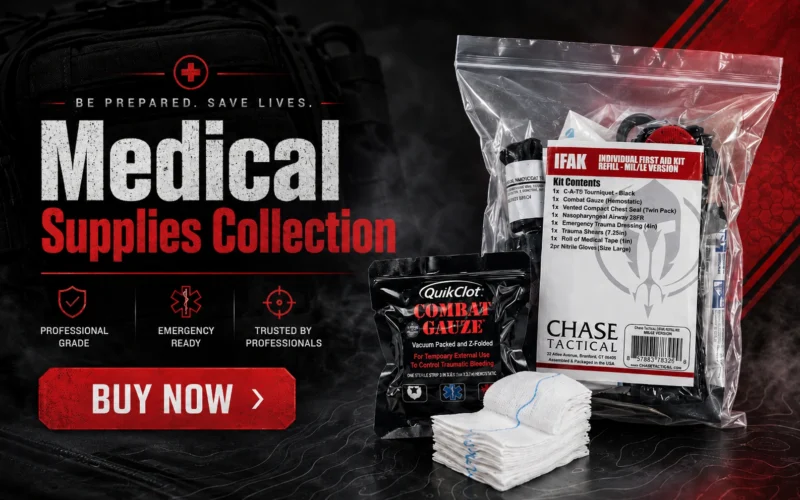
If your IFAK pouch or carrier has additional space, the following items extend your treatment capability beyond the core trauma essentials.
| Item | Purpose | Priority |
| Emergency blanket | Prevents hypothermia in injured casualties | Secondary |
| SAM splint | Immobilizes fractures and sprains | Secondary |
| Wound closure strips | Closes small lacerations temporarily | Secondary |
| Eye shield | Protects penetrating eye injuries | Secondary |
| Medical tape | Secures dressings and seals wounds | Secondary |
| Mini flashlight or penlight | Pupil assessment and low-light wound inspection | Secondary |
Military IFAK Contents: Army, USMC, and Branch-Specific Kits
Every U.S. military IFAK, regardless of branch, is built around the same MARCH-based core: a tourniquet, hemostatic gauze, a pressure bandage or chest seal, and an NPA. What changes between the Army, the Marine Corps, and other branches is less the core items themselves and more the pouch, the packaging, and any unit-specific additions required by standard operating procedure.
Army IFAKs are commonly built around an issued IFAK pouch or a Combat Lifesaver (CLS) bag and may include a second tourniquet, extra gauze, or additional airway components depending on a soldier’s role. USMC IFAKs follow the same core contents but are packaged in Marine Corps issued pouches, and Marines in higher risk roles are often issued a second tourniquet as well. You may also see the term JFAK, short for Joint First Aid Kit, used to describe a similar cross branch kit built around these same life saving items.
If you are building or replacing a kit to match a specific branch’s standard, check your unit’s current packing list first. The items covered in this guide are the core contents every branch treats as non-negotiable, whatever pouch or checklist format your unit uses.
How to Organize and Pack Your IFAK for Speed
Organization is not about neatness. It is about speed under stress. When adrenaline is high and time is critical, your hands need to find the right item without thinking. Follow these principles when packing your kit.
Keep your tourniquet on the outside of the pouch, accessible with one hand. Everything else should be organized in the order you will use it, with the pressure bandage and chest seals near the top. Color-code pouches if your kit allows it, using one section for hemorrhage control and another for airway management. Practice opening and accessing your kit in the dark so that the layout becomes muscle memory.
A simple top-to-bottom layout works well for most kits:
- Tourniquet: on the outside of the pouch or in a dedicated exterior slot for one-handed access
- Pressure bandage and chest seals: top compartment, the first items your hand reaches after the tourniquet
- Hemostatic gauze: packed alongside the pressure bandage for junctional wounds
- NPA, trauma shears, and gloves: middle compartment, grouped together for airway and exposure tasks
- Permanent marker and secondary items: bottom or side pocket, since they are used last
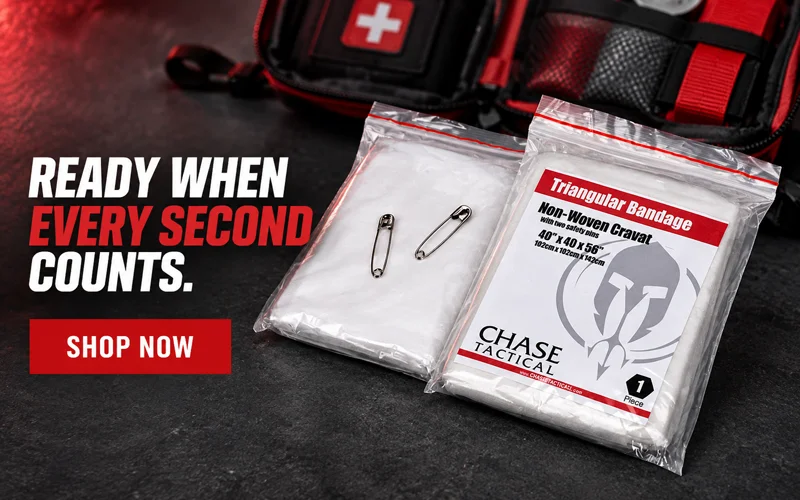
Chase Tactical’s tactical medical kits feature MOLLE-compatible pouches and rapid-access configurations that enable fast deployment in the field. The compact EDC medical kit format is purpose-built to keep essential items organized, protected, and always within reach.
Where to Carry Your IFAK
Standard tactical placement doctrine puts the IFAK on the rear of the duty belt or on a dedicated carrier panel, oriented on the dominant-hand side so either hand can reach it. Do not store it deep inside a backpack or chest rig panel. In a trauma situation, seconds matter and digging through gear for a medical kit is not acceptable.
For civilians and non-tactical users, a belt-mounted or vest-mounted IFAK pouch keeps the kit accessible without drawing attention. The Stop the Bleed campaign recommends keeping a basic bleeding control kit within reach in any environment where an emergency could occur, including vehicles, workplaces, and public spaces.
Conclusion
A properly stocked IFAK is one of the most practical and potentially life-saving investments any tactical professional or prepared civilian can make. The core contents, a tourniquet, pressure bandage, hemostatic gauze, chest seals, NPA, trauma shears, and gloves, address the injuries most likely to cause preventable death in a trauma situation.
Pack it correctly, carry it accessibly, and train with it regularly. An IFAK you know how to use is the only kind that counts. Ready to build or upgrade your kit? Shop Chase Tactical’s IFAK pouches and medical kits to get started.
Frequently Asked Questions
What is the difference between an IFAK and a standard first aid kit?
A standard first aid kit is designed for minor injuries such as cuts, burns, and headaches. An IFAK is a trauma-specific kit built to address life-threatening injuries, including severe bleeding, penetrating chest wounds, and airway obstruction. The contents and purpose are fundamentally different. For a full side-by-side comparison, see our guide on IFAK vs. traditional first aid kits.
Do I need medical training to use an IFAK?
Training is strongly recommended. While IFAK items include instructions, performing procedures such as wound packing or NPA insertion under stress without prior practice significantly reduces their effectiveness. A Stop the Bleed or TCCC course teaches the skills that make an IFAK genuinely useful in an emergency.
How often should I check and replace the contents of my IFAK?
Inspect your IFAK every six months for expired items, damaged packaging, or missing components. Replace any item that has been used or shows signs of degradation. Treat your IFAK the same way you would treat a fire extinguisher: always ready, regularly checked.
Can civilians carry an IFAK?
Yes. There are no restrictions on civilians carrying or owning IFAK contents in the United States. Many civilians, including hikers, hunters, firearms owners, and preparedness-minded individuals, carry IFAKs as part of their everyday gear.
What size IFAK pouch do I need?
A standard 3×6 pouch holds the core items for one casualty. A 6×6 or larger pouch allows you to add secondary items and treat multiple casualties. Choose the size based on your role, mission, and how much additional kit you are willing to carry.
Are the contents of a military IFAK different from a civilian IFAK?
The core contents are the same. Military IFAKs follow the same MARCH-based priorities, a tourniquet, pressure bandage, hemostatic gauze, chest seals, NPA, trauma shears, and gloves, but may add mission-specific items such as a second tourniquet or unit-issued components required by standard operating procedure. A civilian IFAK covers the same core contents scaled to everyday risks like vehicle accidents, hunting, or range days.