







First U.S.- UAE Joint Military AI Task Force Launched

The United States (U.S.) and the United Arab Emirates (UAE) will launch their first bilateral military artificial intelligence (AI) task force in the coming weeks, expanding defense cooperation as both countries seek to accelerate the use of AI in military operations.
The new initiative, called Task Force Talon Synapse, will be based in Abu Dhabi and include about 20 American and Emirati personnel with expertise in AI, data and cybersecurity, the U.S. Central Command (CENTCOM) announced Tuesday.
The task force will focus on integrating AI into intelligence support, protecting critical infrastructure and monitoring the regional security environment. Officials say the effort is designed to speed the adoption of emerging AI technologies while strengthening interoperability between U.S. and Emirati forces. As military organizations around the world increasingly incorporate AI into planning, surveillance and decision-making, both nations view the initiative as an opportunity to improve operational effectiveness while addressing rapidly evolving security challenges across the Middle East.
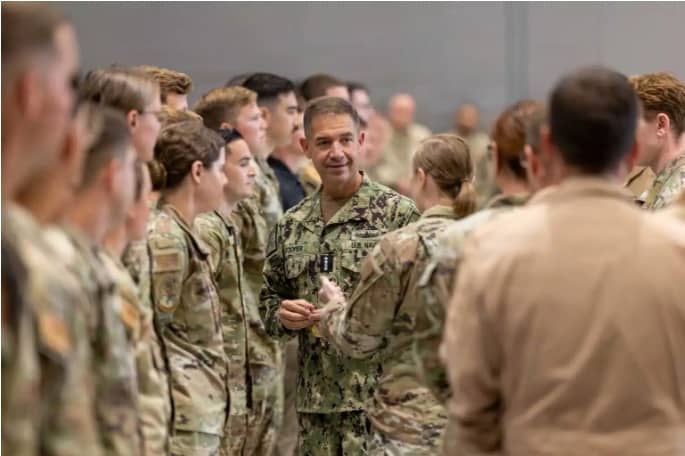
“This will be a historic milestone as we work with one of our most capable regional partners to rapidly deliver evolving AI advancements to our warfighters,” Adm. Brad Cooper, CENTCOM commander, said in a statement.
“Together, we and our Emirati partners share a strong commitment to adopting AI applications that will foster innovation at speed and scale,” he continued.
According to CENTCOM, the initiative grew out of discussions last year between Cooper and UAE National Security Advisor Sheikh Tahnoon bin Zayed Al Nahyan. The two sides also met with AI industry leaders and Emirati defense officials during a regional visit last month before finalizing the agreement.
The announcement marks the first formal bilateral task force dedicated to accelerating military AI development between the U.S. and another country. Beyond supporting current operations, the partnership could serve as a model for future AI collaboration between the United States and other trusted allies. Defense analysts note that as AI becomes more deeply integrated into modern warfare, multinational partnerships focused on responsible development, cybersecurity and data sharing are expected to play an increasingly important role in maintaining regional stability and technological superiority.
While defense officials welcomed the initiative, some experts questioned how much a relatively small team could accomplish and how the partners would manage sensitive intelligence.
“It sounds good on paper, but it’s unclear what will really be tangible will come out of a team of 20 people,” a former senior U.S. defense official told Breaking Defense on condition of anonymity.
“My biggest questions revolve around classified information sharing: what can be shared, at what classification level, and by whom?” the former official said. “It will be great if the U.S. gets access to Emirati data and intelligence that they otherwise might not have access to, but I’m not sure what the Emiratis gain in return.”
The concerns underscore one of the most significant challenges facing international AI partnerships. While AI systems can process enormous amounts of information and improve situational awareness, their effectiveness often depends on access to highly sensitive data. Establishing secure protocols for sharing intelligence while protecting national security interests will likely be one of the task force's most important responsibilities as it begins operations.
The U.S. and UAE have expanded defense cooperation in recent years. Earlier this year, the UAE reportedly carried out covert airstrikes against Iran in support of the U.S.
Under the Trump administration, the two countries have also expanded cooperation on technology despite objections from some career U.S. officials, who argue the UAE's ties to China could increase the risk of U.S. technology being exposed.
Earlier this month, the Trump administration elevated the UAE to the same U.S. export category as European allies, South Korea and India, giving it expanded access to U.S. advanced technology, military equipment and energy infrastructure with potential military applications.
“Consistent with the U.S.-UAE Artificial Intelligence Cooperation framework signed in May 2025, Commerce is approving the UAE Government and certain companies to receive advanced computing items in the UAE license-free, including AI chips and servers,” the U.S. Department of Commerce said. “The UAE has reaffirmed its commitment to the investment commitments in the framework, including the commitment to make matching investments in U.S. AI digital infrastructure buildout.”
Previously, the UAE was subject to stricter export controls alongside countries including China and Yemen.
The launch of Task Force Talon Synapse reflects the growing importance of AI as a strategic capability in national defense. While questions remain about the task force's size, long-term impact and intelligence-sharing framework, the initiative represents another step in the broader effort by the United States and its allies to integrate advanced AI technologies into future military operations while strengthening regional security partnerships.