








Velcro Placards for Plate Carriers, What They Are and Why Operators Use Them

A Velcro placard is a hook-and-loop panel that mounts to the front of a plate carrier, giving operators a fast way to swap an entire loadout without touching a single strand of MOLLE webbing. Instead of unweaving pouches one at a time, you peel the whole panel off and press a different one on in seconds. That speed is the entire point, and it is why placards have become standard equipment across military, law enforcement, and civilian tactical setups.
This guide breaks down what a Velcro placard actually is, how it attaches to a carrier, and the situations where it earns its place on your kit over standard MOLLE.
What Is a Velcro Placard?
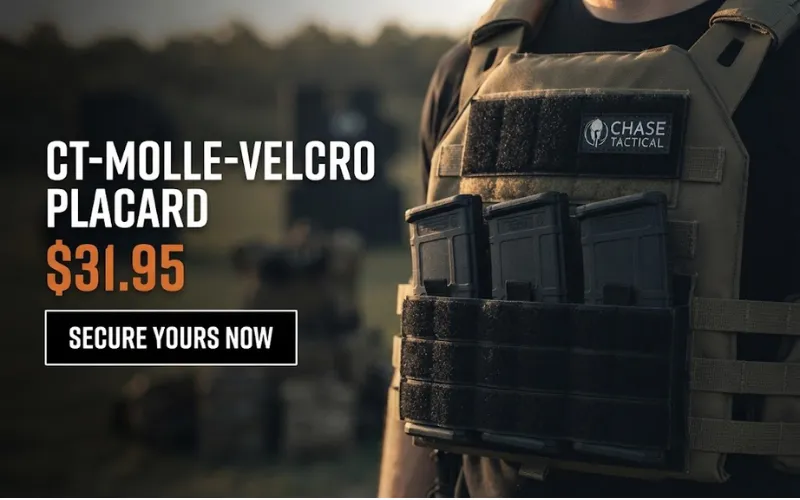
A Velcro placard is a rigid or semi-rigid panel covered in hook-and-loop material on the back side and often on the front as well. It attaches to the plate carrier’s front panel, either directly onto an existing hook field or through an aftermarket adapter that adds loop space to a carrier that did not ship with one. Once the placard is in place, you can mount patches, small pouches, or an entire pre-built gear panel on it.
Placards differ from a full MOLLE-webbed front panel in one key way: they are built for repositioning and swapping, not for permanent, heavy-load carry. A rifle mag pouch woven onto MOLLE stays put through a hard fall or a vehicle extraction. A placard panel is designed to come off cleanly and on purpose in a few seconds.
How a Velcro Placard Attaches to a Plate Carrier
Most carriers that support placards use one of two setups:
- Built-in loop field: Some plate carriers ship with a large Velcro loop panel already sewn into the front, so any hook-backed placard or patch presses on directly.
- Aftermarket adapter panel: Carriers without a factory loop field can add one with a product like the Chase Tactical MOLLE Velcro Placard, which straps onto any standard MOLLE surface and adds a large hook-and-loop field where there wasn’t one before.
Once the loop field is in place, attaching a placard is straightforward: press it on, smooth it down, and confirm full contact across the panel so it doesn’t peel at the corners when moved.
Why Operators Use Velcro Placards
Fast Mission-to-Mission Reconfiguration
The single biggest reason operators run a placard system is speed of reconfiguration. Swapping from a patrol loadout to a specialized mission setup means changing an entire panel of gear at once rather than re-threading a dozen MOLLE straps. For units or individuals who rotate between roles in a single shift, this matters.
Admin, ID, and Patch Space
Not every item on a plate carrier needs to bear weight. Name tapes, blood type patches, unit identifiers, and IR-reflective ID panels all work better on Velcro than on MOLLE, since they need to be visible and swappable rather than load-rated. A placard gives you dedicated real estate for this without eating into your MOLLE rows.
Lower Profile Under a Uniform or Outer Layer
A well-fitted placard panel sits flatter against the carrier than a stack of MOLLE-mounted pouches, which helps when a low profile matters, such as under a jacket or in a vehicle seat.
When MOLLE Still Wins Over a Placard
Placards are not a full replacement for MOLLE, and they were never meant to be. Hook-and-loop retention weakens over time as dirt, moisture, and repeated use degrade the hook fibers, so heavy or mission-critical gear, rifle magazines, trauma kits, and anything you cannot afford to lose in a fall, belongs on woven MOLLE, not a Velcro field. Most experienced operators run both systems together: MOLLE on the sides and back for load-bearing pouches, and a Velcro placard up front for the gear that benefits from fast swaps. For a full comparison of when to lean on each system, see our MOLLE vs. Velcro attachment guide, and for a breakdown of placards against a full chest rig setup, see Placards vs. Chest Rigs.
The Pouch Attachment Ladder System that underlies MOLLE was developed by the U.S. Army Natick Soldier Center and remains standardized under military specifications, which is part of why woven MOLLE retention is treated as the load-bearing baseline across military and law enforcement procurement (U.S. Army).
Choosing a Placard Setup for Your Plate Carrier
If your carrier already has a factory loop field, you only need to source placards or patches sized to fit it. If it doesn’t, an aftermarket panel like the Chase Tactical MOLLE Velcro Placard solves that by adding a large loop surface to any MOLLE-equipped carrier. From there, decide what actually needs to live on the placard versus what belongs on MOLLE: ID and admin items on the Velcro, load-bearing gear on the webbing.
Frequently Asked Questions
Do all plate carriers support Velcro placards?
No. Some carriers ship with a built-in loop field ready for placards, while others need an aftermarket adapter panel that straps onto MOLLE webbing to add hook-and-loop space.
Is a Velcro placard strong enough for rifle magazines?
Not reliably over time. Hook-and-loop retention weakens with dirt, moisture, and repeated use, so rifle magazines and other mission-critical gear are better suited to MOLLE-mounted pouches.
Can I run both MOLLE and a Velcro placard on the same carrier?
Yes. Most operators combine both, using MOLLE for load-bearing pouches on the sides and back and a Velcro placard on the front for patches, ID, and quick-swap items.
What is the main advantage of a placard over MOLLE?
Speed. A placard lets you swap an entire front panel of gear in seconds, while reconfiguring MOLLE means re-threading straps one pouch at a time.