








Top General Warns US Troops Will Be Hunted by Autonomous AI

The chairman of the Joint Chiefs of Staff delivered an unusually stark message to the U.S. military's officer corps this week: assume the enemy can already see you, jam you, and send a machine to kill you.
Speaking Wednesday in a keynote at the Air & Space Forces Association's Air, Space & Cyber Conference in National Harbor, Maryland, Gen. Dan Caine told the room that "we have to assume from now on that our formations will be hunted by autonomous systems, jammed across the spectrum and tracked in real time". It's a line meant less as a warning about some distant future than a description of conditions U.S. forces are living with right now.
Caine framed his remarks around a single throughline: the character of war is changing faster than most institutions can adapt to it, and the battlefield already offers a preview of what's coming. He pointed to Ukraine, where first-person-view drones are operating inside heavily jammed electromagnetic environments, some now flying on AI-enabled computer vision that keeps them locked onto a target even after GPS is denied or the control link is severed.
The human cost of that shift, he said, is measurable. On parts of the front line, he noted, the life expectancy of a newly arrived Russian recruit can be as short as 20 to 30 minutes — a statistic he offered as a blunt illustration of what happens when cheap, precise weapons get fielded fast and scaled across a battlefield.
Caine's broader argument was about tempo. Advantage, he said, will belong to whichever side can see first, understand first, decide first and act first — and keep learning faster than its adversary. He tied that to a call for the Pentagon to move faster on acquisition, lower costs and get combat-ready systems into the field sooner, rather than chasing requirements that are already obsolete by the time they're funded.
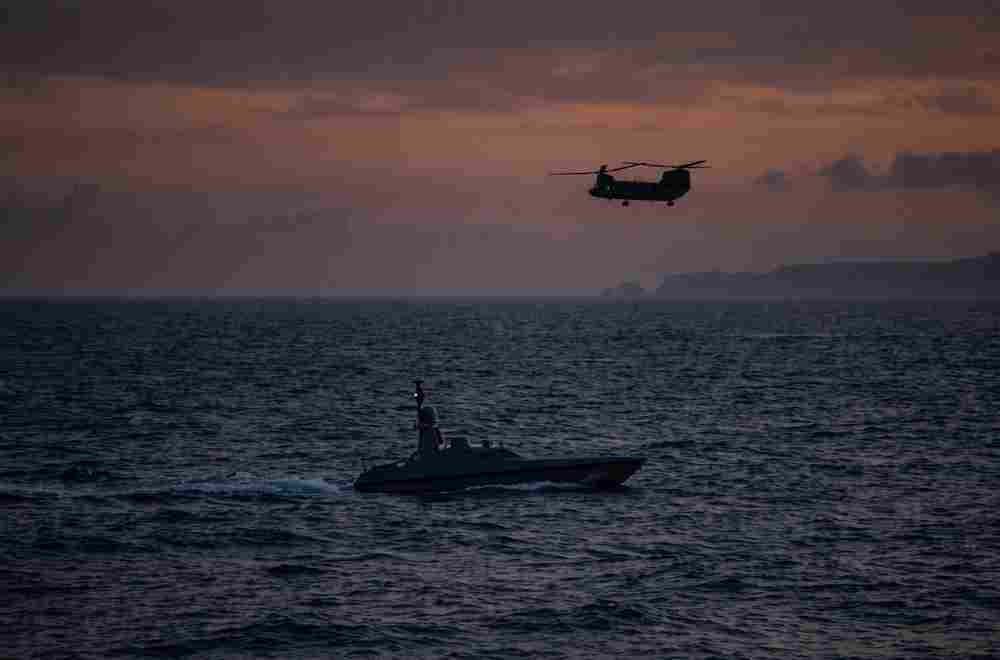
Rather than speak only in hypotheticals, Caine pointed to an operation from earlier this year as evidence that the force is already adapting. In June, an Army AH-64 Apache helicopter went down near the Strait of Hormuz off the coast of Oman during the conflict with Iran, with both crew members stranded in the water. Task Force 59, U.S. 5th Fleet's unmanned-systems unit, dispatched a Saronic-built Corsair unmanned surface vessel to locate the pilots; the drone picked them up and ferried them to a rendezvous point where they were hoisted to a helicopter, with both soldiers rescued within about two hours. It marked the U.S. military's first publicly confirmed use of an autonomous surface vessel to recover downed aircrew in actual combat conditions.
Caine credited the outcome not to the technology alone but to the sailors of Task Force 59 who had spent years testing and operationalizing unmanned systems before the mission ever mattered. "That capacity did not appear overnight," he told the conference, describing a team using AI to fuse sensor data across thousands of miles of water into what he called a clear maritime picture.
Caine's remarks landed alongside a related theme running through the rest of the conference. Brig. Gen. Todd Benson, commander of Space Forces Central, told reporters at a roundtable a day earlier that the military is entering an era of "hyper-transparent warfare", where satellite imagery has become accessible enough that even small nations or non-state groups can track American forces — a dynamic he said cuts both ways for U.S. operators.
That transparency problem isn't abstract for U.S. forces in the Middle East. The State Department said in May that Iran has used satellite imagery supplied by Chinese companies to help strike American positions during the ongoing conflict, part of a broader pattern of technological cooperation between Tehran and Moscow. Indeed, Russia and Iran have deepened their military partnership into something resembling a feedback loop, with Moscow supplying Iran upgraded munitions, satellite imagery and targeting data even as Tehran continues supplying and now licensing production of Shahed-style attack drones that Russia has used against Ukraine.