








Essential Police Gear: Must-Have Equipment for Law Enforcement Officers


Law enforcement officers operate in unpredictable, high-risk environments where the right gear is the difference between going home and not. Every piece of equipment on an officer’s duty belt, plate carrier, or gear bag has a specific function – from stopping ballistic threats to restraining suspects to providing immediate medical aid in the field. Choosing and maintaining that gear correctly is not optional. It is fundamental to officer safety and operational effectiveness.
This guide covers the essential police gear every officer should carry on patrol – from the duty belt and body armor that form the foundation of any loadout, to communication devices, non-lethal tools, medical kits, and tactical lighting. Each section covers what the gear does, what to look for when selecting it, and high-quality options from Chase Tactical built and tested for law enforcement use.
87% of police departments issue ballistic vests to all frontline officers
92% of officers carry body cameras during shifts
76% of officers rely on Tasers as a non-lethal force option
99.3% of law enforcement personnel carry standard-issue handcuffs
Essential Police Gear: Quick Reference Checklist
The table below summarizes the essential gear every law enforcement officer should carry on duty, organized by category.
| Category | Essential Items | Primary Purpose |
| Protective Gear | Body armor vest, plate carrier, riot suit, tactical helmet | Ballistic and blunt-force protection |
| Duty Belt | Holster, handcuffs, baton, radio pouch, spare magazine pouches, pepper spray | Carry and access all patrol tools |
| Restraint Tools | Handcuffs, zip ties, leg restraints | Suspect control and detention |
| Non-Lethal Force | Taser / CEW, pepper spray (OC spray), baton | Subject control without lethal force |
| Firearms & Ammunition | Duty firearm, spare magazines, ammunition | Use of force / lethal threat response |
| Medical / First Aid | IFAK / trauma kit, tourniquet, chest seal, trauma shears | Immediate field trauma response |
| Communication | Police radio, radio pouch, body camera | Coordination and evidence documentation |
| Tactical Lighting | Flashlight, weapon-mounted light | Low-light visibility and threat identification |
| Footwear & Clothing | Tactical boots, duty uniform, tactical gloves | Mobility, weather protection, hand safety |
| Storage & Carry | Utility pouches, ammo pouches, tactical bags, chest rig | Gear organization and accessibility |
1. Body Armor and Protective Gear

Protective gear is the foundation of any law enforcement loadout. It covers everything from ballistic vests and hard armor plates to riot suits and tactical helmets – each serving a distinct role depending on the officer’s assignment and threat environment. Approximately 87% of law enforcement departments issue ballistic vests to all frontline officers, making body armor the single most critical piece of essential police gear on this list.
Body Armor Vests
Body armor is fundamental for law enforcement, providing protection against ballistic threats on patrol. Body armor for police is rigorously tested to meet NIJ standards, ensuring it can withstand multiple impacts and high-velocity rounds. The ergonomic design allows officers to wear it for extended shifts without discomfort, making it reliable in the field.
Most patrol officers wear Level IIIA soft body armor as their daily vest – rated to stop handgun rounds up to .44 Magnum while remaining flexible and lightweight enough for a full shift. Officers in tactical or high-risk roles add Level III or Level IV hard armor plates in a plate carrier for rifle-rated protection. Understanding which body armor level matches your patrol environment is the starting point for any protective gear decision.
Benefits of body armor on duty:
- Provides critical protection against bullets, stab wounds, and physical attacks, reducing the risk of fatal injury
- NIJ-certified armor has been shown to significantly improve survival rates for officers in active shooter and use-of-force situations
- Modern soft armor is lightweight and breathable – officers can wear it for a full 8-12 hour shift without being physically impaired
Chase Tactical’s TITAN Level III Ballistic Shield provides certified NIJ 0108.01 rifle protection in a lightweight UHMWPE design:
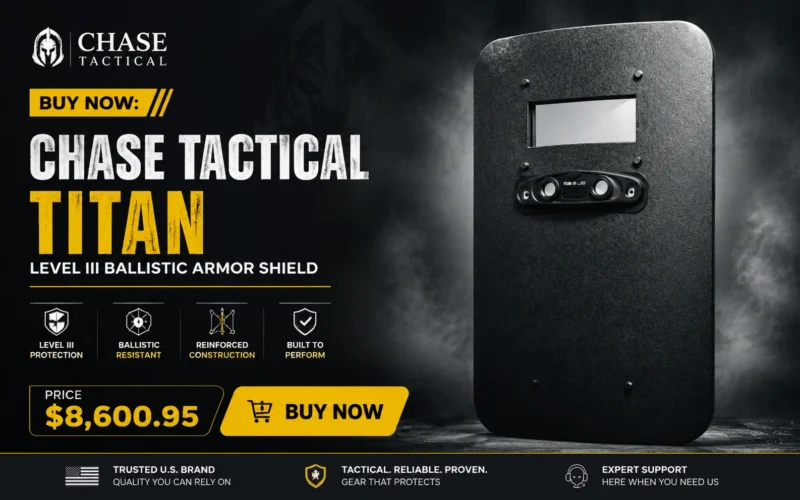
Plate Carriers And Chest Rigs
Plate carriers and chest rigs are essential for carrying body armor plates and additional gear, allowing officers to access equipment quickly while maintaining mobility. Chase Tactical offers durable options with MOLLE webbing for customizable loadouts. The plate carriers distribute weight evenly, reducing fatigue and allowing a full range of motion during extended operations.
For patrol officers, a low-profile plate carrier worn over soft armor provides full-spectrum ballistic coverage – soft armor handles handgun threats while hard plates stop rifle rounds. For tactical units and active shooter response, a higher-capacity carrier with MOLLE-compatible pouches for spare magazines, medical supplies, and communication gear is the appropriate setup. Level IV armor for law enforcement is increasingly deployed in active shooter response kits at the department level.
Key benefits on duty:
- MOLLE webbing allows customizable attachment of pouches, holsters, and accessories around the carrier
- Weight is distributed across the chest and shoulders, reducing lower back strain during long shifts
- Adjustable straps and padding provide a secure, comfortable fit across different body types
Riot Suits
Riot suits provide full-body protection in crowd control and riot response situations, protecting officers against blunt force trauma, thrown projectiles, and direct physical contact. The Chase Tactical Field Force Police Riot Suit offers comprehensive protection with a durable design covering the upper body, shoulders, forearms, thighs, groin, knees, and shins – ensuring complete coverage of all major impact zones.
- High-impact resistant materials and foam padding for durability and comfort during extended deployment
- Soft brush and mesh lining for breathability during prolonged wear
- Includes storage and carry bag with riot gloves featuring Kevlar reinforcement
- Designed to allow full freedom of movement for crowd management maneuvers
Tactical Helmets
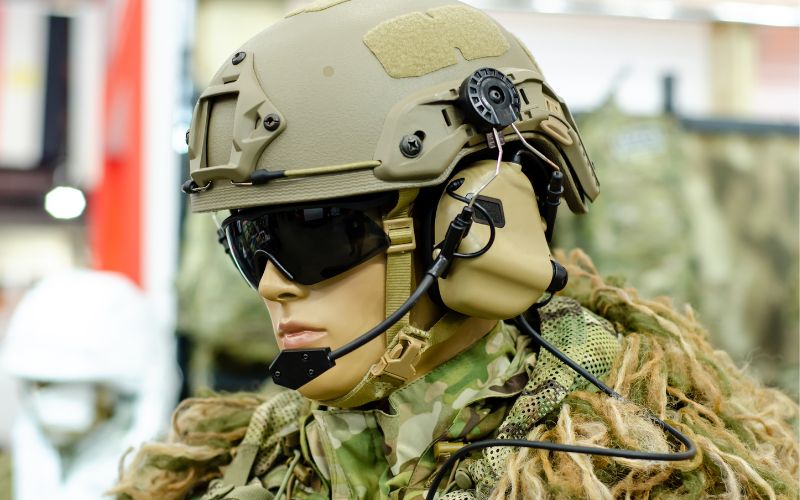
Tactical helmets provide critical head protection and enhance operational capabilities by allowing for the attachment of accessories such as night vision devices and communication systems. Chase Tactical’s helmets are available in ballistic and non-ballistic options, offering high-impact resistance and adjustable suspension systems for a secure and comfortable fit. These helmets are designed to protect against blunt force trauma and ballistic threats, making them indispensable in high-risk situations.
2. The Duty Belt: Core of Every Patrol Loadout
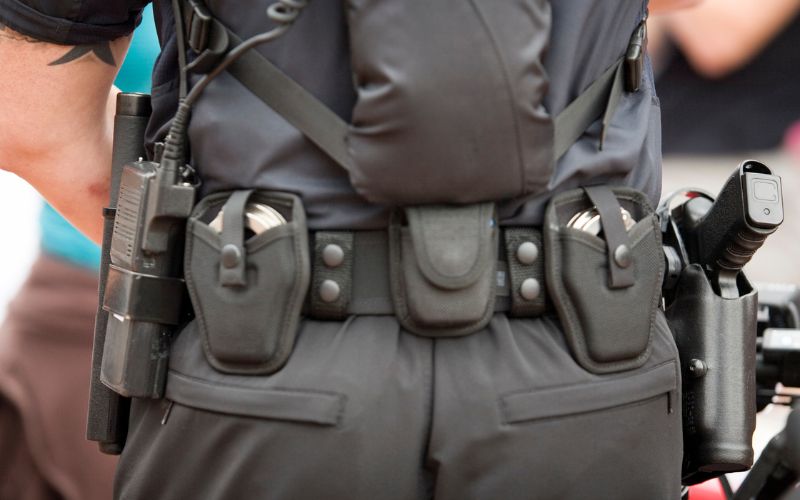
The duty belt is the operational center of a patrol officer’s gear. It carries the firearms, restraints, communication tools, and non-lethal devices that officers rely on throughout their shift. A properly configured duty belt distributes weight evenly around the waist, keeps all essential tools accessible under stress, and keeps the officer’s hands free for movement and use of force when needed.
Made from reinforced nylon or leather, the duty belt is built to withstand the rigors of daily patrol use. It includes modular pouches and holsters that can be configured to match the officer’s specific loadout, a quick-release buckle for emergency situations, and additional attachment loops for supplemental gear. Adjustable sizing ensures a secure fit for officers of all builds.
What Goes on a Standard Duty Belt
- Firearm holster: Positioned for dominant-hand draw, typically with Level II or Level III retention to prevent unauthorized access
- Handcuff case: Double-lock handcuffs in a belt-mounted pouch for rapid deployment during an arrest
- Spare magazine pouches: One or two spare loaded magazines for the duty firearm
- Radio and radio pouch: Police radio for communication with dispatch and other units
- Baton and baton ring: Expandable or fixed baton for use-of-force situations
- Pepper spray / OC spray holder: Non-lethal chemical irritant for subject control
- Taser holster: Non-dominant side for cross-draw to prevent weapon confusion with the firearm
- Flashlight holder: Full-size flashlight for low-light environments and night patrol
- Glove pouch: Nitrile or tactical gloves for evidence handling and protection
- Medical pouch: Tourniquet or mini IFAK for immediate field trauma response
Benefits of a properly configured duty belt:
- Even weight distribution across the waist prevents lower back strain during long shifts
- All essential tools are within immediate reach without requiring the officer to search or unholster unnecessarily
- Modular design allows configuration to be adjusted for specific assignments – patrol, traffic, special events
- Quick-release buckle enables fast removal in emergencies
3. Restraint Tools: Handcuffs and Cuffs
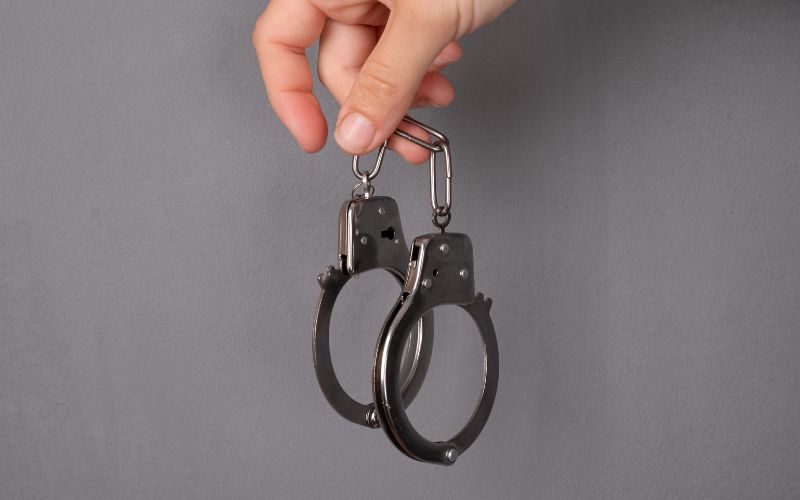
Handcuffs are one of the most fundamental items in essential police gear. Used by 99.3% of law enforcement personnel globally, they restrain individuals who are under arrest or pose a threat, limiting mobility and ensuring the safety of both the officer and the subject during arrest and transport. Modern handcuffs are manufactured from high-strength stainless steel, ensuring durability and resistance to tampering.
A double-lock mechanism prevents over-tightening and secures the cuffs more effectively once applied. Size and weight are optimized for belt carry without adding unnecessary load. Handcuffs are typically carried in a dedicated pouch on the duty belt for one-handed deployment under stress. Training in correct application technique is essential – properly applied cuffs must be checked for fit and double-locked immediately after application.
Beyond standard handcuffs, officers may also carry flex cuffs (zip tie-style restraints) for mass-casualty or multi-arrest scenarios where rigid cuffs are insufficient in quantity, and leg restraints for subjects who present a kicking risk during transport. Each restraint type serves a specific use case and officers should be trained on all options available to their department.
Safety Points Of Having Handcuffs On Duty
- Handcuffs effectively prevent detainees from escaping custody, ensuring they remain controlled until they can be properly processed.
- By restraining individuals, handcuffs reduce the risk of officers being assaulted or injured during an arrest or transport.
4. Firearms and Ammunition
The duty firearm is the primary tool of force available to law enforcement officers. Standard-issue firearms for patrol officers in the United States are typically semi-automatic pistols chambered in 9mm, .40 S&W, or .45 ACP, carried in a retention holster on the dominant side of the duty belt. Over 92% of U.S. law enforcement agencies issue semi-automatic pistols as the standard duty weapon.
Ammunition selection for duty use is made at the department level and follows specific performance requirements – typically jacketed hollow point (JHP) rounds designed to expand on impact and reduce overpenetration risk. Officers carry at minimum one spare loaded magazine on the duty belt, and tactical officers may carry two or more for extended operations.
Proper maintenance of the duty firearm is critical. Officers must follow their department’s cleaning and inspection schedule, and any firearm that has malfunctioned, been dropped, or exposed to significant impact must be inspected by an armorer before returning to service. Holster fit must be verified whenever a new firearm or holster is issued – the holster must retain the firearm securely through the full range of duty movement.
Firearm and ammunition essentials on duty:
- Department-issued semi-automatic pistol in an approved caliber
- Duty-grade jacketed hollow point ammunition – inspect rounds periodically for corrosion or deformation
- Minimum one spare loaded magazine; two for tactical assignments
- Level II or Level III retention holster appropriate for the duty firearm model
- Regular cleaning and function-check schedule per department policy
5. Non-Lethal Force Tools: Taser, Pepper Spray, and Baton
Non-lethal force tools give officers the ability to control subjects and de-escalate dangerous situations without resorting to lethal force. More than 76% of law enforcement officers rely on Tasers as a primary non-lethal force option. These tools occupy a critical position in the use-of-force continuum and must be carried and maintained correctly to function reliably when needed.
Taser / Conducted Energy Weapon (CEW)
The Taser is a conducted energy weapon that discharges two probes connected by wires, delivering electrical pulses that cause temporary neuromuscular incapacitation – effectively stopping a subject’s voluntary muscle control without causing permanent injury in most applications. It allows officers to safely disable a non-compliant subject at a distance of up to 15-25 feet, significantly reducing physical confrontation risk for both officer and subject.
Tasers are carried on the non-dominant side of the duty belt and must be cross-drawn – never on the same side as the duty firearm. This is a critical safety protocol that prevents weapon confusion under stress. Officers must complete department-approved CEW certification and refresher training to maintain authorization to carry.
Benefits of Tasers on duty:
- Enables officers to disable a non-compliant subject without physical contact, reducing injury risk for both parties
- Provides a safer alternative to lethal force in situations where deadly force is not yet justified
- Effectiveness is documented – over 76% of officers report Tasers as their primary non-lethal force tool
Pepper Spray (OC Spray)
Pepper spray – oleoresin capsicum (OC) spray – is a fast-acting non-lethal agent that incapacitates hostile persons by causing intense irritation to the eyes, nose, and upper respiratory system. It creates immediate disorientation and temporary vision impairment, giving officers the time needed to safely control and restrain a subject.
Advantages on duty:
- Near-instantaneous effect in most applications, providing immediate relief in hostile confrontations
- Non-lethal mechanism minimizes the risk of permanent injury while effectively managing an active threat
- Compact, belt-mounted canister is always accessible without removing hands from the situation
Baton
The baton is a close-range impact tool used for subject control when other non-lethal options have failed or are not appropriate for the distance or situation. Most patrol officers carry an expandable (ASP-style) baton that collapses for compact carry on the duty belt and extends to full deployment with a single wrist motion. Fixed batons are used in riot control and correctional environments where a longer reach and greater rigidity are required.
Effective baton use requires specific training in target zones, deployment technique, and departmental use-of-force policy. Officers must carry the baton in an approved ring or holster on the duty belt with the handle oriented for the correct draw direction, and must complete periodic recertification in baton technique as required by their department.
6. Medical Kits and First Aid Supplies
A well-equipped medical kit is critical for immediate response to injuries and trauma in the field. Law enforcement officers are frequently the first to arrive at scenes involving gunshot wounds, stab wounds, and major trauma – often well before EMS. The ability to apply a tourniquet, pack a wound, or seal a chest wound in the first minutes after an injury is the difference between survival and preventable death.
Every officer should carry at minimum an Individual First Aid Kit (IFAK) on their person – not just in the vehicle. An IFAK for law enforcement should include a tourniquet (CAT or SOFTT-W), hemostatic combat gauze, a pressure bandage, a chest seal (vented), trauma shears, and nitrile gloves. Chase Tactical’s medical kits are designed for rapid field deployment, featuring quick-access pouches that can be opened with one hand under stress.
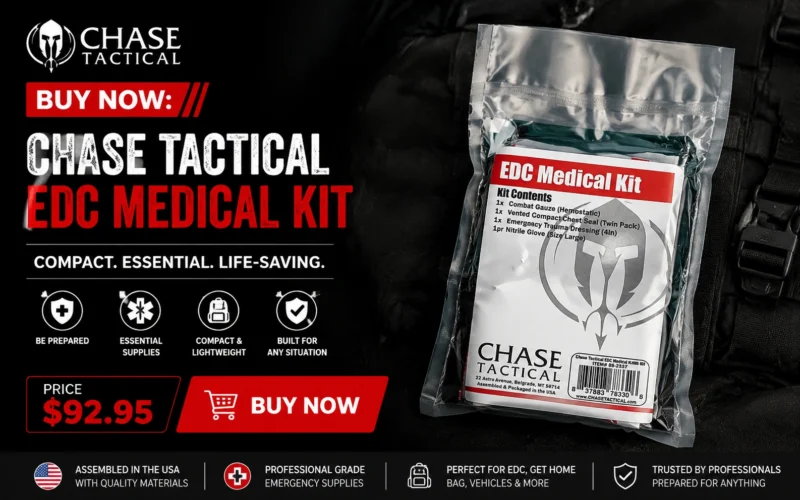
The Chase Tactical EDC Medical Kit – vacuum sealed with combat gauze, chest seal, trauma dressing, and gloves for compact, ready trauma response:
What an officer’s IFAK should contain:
- Tourniquet (CAT or SOFTT-W) – for extremity hemorrhage control
- Hemostatic combat gauze – for wound packing and hemorrhage control
- Pressure bandage / trauma dressing
- Chest seal (vented) – for penetrating chest wounds
- Trauma shears – for cutting clothing and gear to access wounds
- Nitrile gloves – barrier protection during patient care
- Nasopharyngeal airway (NPA) – for airway management
7. Communication Devices: Radio and Body Camera
Communication equipment is mission-critical for law enforcement. Officers must be able to coordinate with dispatch, call for backup, and share situational information with other units in real time. Communication failures in the field directly increase officer risk. Every officer on patrol should carry a functioning police radio at all times, tested before each shift.
Police Radio
The police radio (portable transceiver) is the primary communication tool for patrol officers. It connects the officer to dispatch, supervisors, and other units on the same channel, allowing rapid coordination during calls for service, pursuits, and use-of-force situations. Radios are typically carried in a radio pouch on the duty belt or chest rig, with a shoulder-mounted speaker-microphone for hands-free communication.
Radio discipline – proper channel use, clear transmission, and brevity – is as important as the equipment itself. Officers must verify battery charge and radio function at the start of every shift and carry a spare battery for extended deployments. A radio pouch on the chest rig or duty belt keeps the transceiver accessible and protected during physical activity.
Body Camera
Body-worn cameras (BWC) have become standard equipment in most U.S. law enforcement agencies – over 92% of officers carry body cameras during their shifts. BWCs document officer interactions, use-of-force events, and evidence collection in real time, providing objective video records that protect both officers and the public. Most BWCs attach to the front of the uniform or plate carrier and activate automatically or via a manual button.
Officers must follow department policy on camera activation – many departments require automatic activation at the beginning of any enforcement contact. Camera batteries must be checked before each shift, and footage is typically uploaded to a secure cloud evidence management system at the end of the shift.
8. Flashlights and Tactical Lighting
Flashlights are essential police gear for every patrol officer, regardless of shift time. Tactical lighting is used for building searches, vehicle stops, suspect identification, and evidence documentation in low-light or no-light environments. An officer without a functioning flashlight is operationally compromised on any call that requires entry into a darkened structure or vehicle.
A full-size flashlight (500-1,000+ lumens) carried in a belt holster is standard for patrol. A weapon-mounted light on the duty firearm provides additional illumination during tactical entry situations, keeping both hands free for weapon manipulation. Officers in tactical units may additionally carry a handheld backup light and helmet-mounted light for hands-free operation during searches.
What to look for in a duty flashlight:
- Minimum 500 lumens for outdoor use; 1,000+ lumens recommended for tactical applications
- Durable aluminum or polymer body with a waterproof rating of at least IPX4
- Multiple modes: high, low, and strobe for subject disorientation
- Belt-compatible holster for secure carry and one-hand access
- Rechargeable battery with sufficient runtime for a full shift
9. Footwear and Tactical Gloves
Tactical Boots
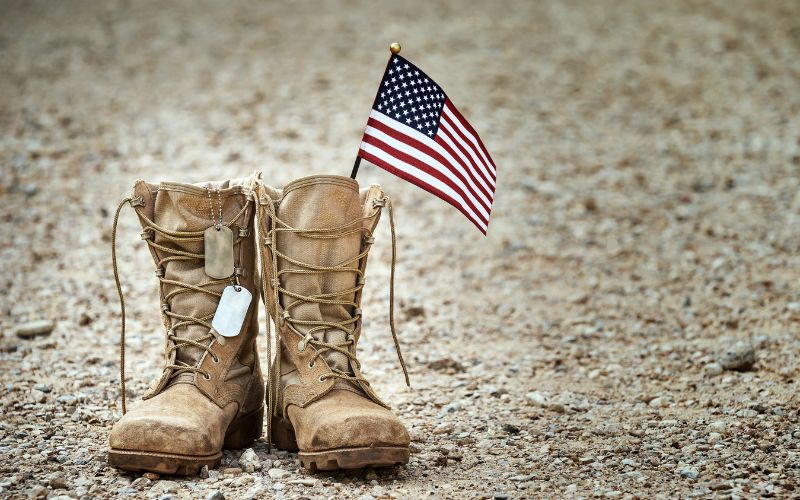
Law enforcement officers spend the majority of their shift on their feet – walking, standing, running, and navigating varied terrain. Tactical boots must provide ankle support for stability and injury prevention, slip-resistant soles for traction on wet or uneven surfaces, and durable construction that withstands the daily demands of patrol work. The right boots significantly reduce foot fatigue, which directly affects officer performance and alertness over long shifts.
For patrol officers, a lightweight boot with a composite or soft toe is generally preferred over a steel-toe work boot – composite toe provides toe protection with less weight, and soft-toe boots allow faster movement during foot pursuits. Waterproof construction is important for officers in wet climates or for those who work outdoor assignments. Side-zip boots allow faster on/off during shift changes or medical calls.
What to look for in duty boots:
- Durable materials – full-grain leather, 1000D nylon, or high-grade synthetic construction
- Ankle support for stability on varied terrain
- Slip-resistant outsole for wet surfaces and stairwells
- Waterproof and breathable lining – Gore-Tex or equivalent
- Lightweight construction (under 2 lbs per boot) to reduce fatigue
- Composite or soft toe for mobility; steel toe optional for vehicle or building search work
- Cushioned insole for comfort during extended standing and walking
Tactical Gloves
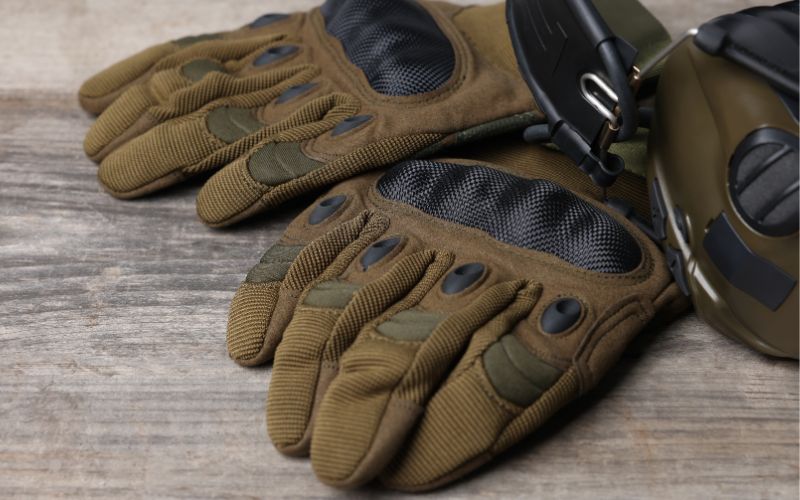
Tactical gloves are essential for protecting hands while maintaining dexterity. Chase Tactical’s gloves are made from durable, cut-resistant materials like Kevlar, featuring reinforced knuckles and fingertips for added protection. These tactical gear gloves are designed to provide you with a secure grip and comfortable fit, allowing officers to handle weapons and equipment easily. Breathable fabrics ensure comfort during prolonged use, making these gloves a reliable choice for any operation.
Benefits Of Wearing Tactical Gloves On Duty
- Kevlar or other cut-resistant fabrics.
- Reinforced knuckles and fingertips.
- Breathable and ergonomic fit.
- Ensures firm handling of weapons and tools.
- High resistance to abrasions and cuts.
- Allows for precise movements and control.
10. Utility Pouches, Ammo Pouches, and Tactical Bags

Utility and ammo pouches are crucial for organizing gear and ensuring that essential items are easily accessible. Chase Tactical’s pouches are designed with MOLLE webbing to secure tactical gear attachment. They are made from durable materials and feature robust zippers and fasteners to withstand the rigors of the field. Available in various sizes, these pouches can accommodate different types of equipment and ammunition, making them versatile additions to any tactical setup.
Tactical bags serve officers who need to transport gear between the vehicle and a scene – evidence collection equipment, additional medical supplies, spare ammunition, and personal items. Officers should choose bags with dedicated compartments that keep items separated and organized, MOLLE-compatible exterior for attaching additional pouches, and water-resistant materials to protect sensitive equipment. A grab-and-go bag in the patrol vehicle configured for active shooter response – plate carrier, Level IV plates, medical kit – is increasingly standard practice in law enforcement.
Pouch and storage essentials on duty:
- MOLLE-compatible attachment for versatile positioning on plate carriers, belts, and chest rigs
- Robust zippers and fasteners rated for repeated daily use under load
- Various sizes – single-stack magazine pouches, double-stack pouches, utility pouches for tools and accessories
- Quick-retrieval design for one-hand access to high-priority items under stress
- High-quality nylon or Cordura fabric for durability and weather resistance
11. Active Shooter Kits
Active shooter kits are designed for immediate response to active shooter scenarios – the highest-risk, time-critical law enforcement events that require officers to deploy rapidly with maximum protection and medical capability. Chase Tactical’s active shooter kits include plate carriers, armor plates, and trauma kits in a single grab-and-go package that can be deployed from a patrol vehicle in under 60 seconds.
Shop the MEAC Active Shooter Response Kit – includes plate carrier, Level IV armor plates, tourniquets, and trauma supplies designed for law enforcement active shooter response.
What an active shooter kit should include:
- Plate carrier with Level IV armor plates for rifle and armor-piercing protection
- IFAK with tourniquet, chest seal, hemostatic gauze, and trauma shears
- Grab-and-go design for vehicle deployment – stored accessible, not buried in the trunk
- High-quality, department-appropriate materials rated for immediate use
12. Police Uniform and Patrol Clothing
The police uniform is the visible representation of law enforcement authority and the base layer of the officer’s protective system. A well-chosen duty uniform must withstand the physical demands of patrol – from sitting in a vehicle for hours to foot pursuits – while maintaining a professional appearance and supporting the gear worn over it.
Duty shirts and pants for law enforcement are typically made from ripstop nylon or poly-cotton blends that resist tearing, hold their shape after repeated washing, and breathe well during active work. Reinforced knees in duty pants protect during kneeling on hard surfaces. Cargo pockets provide additional on-body storage without requiring belt pouches. Department uniform specifications vary, but the principle is consistent: function and durability first.
What to look for in duty uniforms:
- Ripstop fabric construction for tear resistance during physical engagement
- Articulated knees and gusset crotch for full range of motion
- Cargo pockets for on-body storage of gloves, notepad, or small tools
- Moisture-wicking and breathable construction for comfort during extended wear
- Reinforced seat and knee areas for high-wear zones
- Department-compliant color and configuration
13. Maintaining Your Police Gear
Equipment that is not maintained is equipment that will fail – often at the worst possible moment. Regular inspection and maintenance of all duty gear is as important as selecting the right gear in the first place. Every officer should follow a consistent maintenance schedule for every item in their loadout.
| Gear Item | Maintenance Frequency | Key Checks |
| Duty firearm | After every use / weekly minimum | Function check, clean, inspect for damage, verify holster fit |
| Body armor / soft vest | Every 6 months / after any impact | Inspect panels for tears, moisture damage, delamination; replace every 5 years |
| Hard armor plates | Every 6 months / after any ballistic hit | Inspect for cracks, coating damage; retire any plate that has taken a hit |
| Handcuffs | Weekly | Double-lock function, hinge or chain integrity, key operation |
| Taser | Before each shift | Battery charge, spark test, probe cartridge integrity |
| Radio | Before each shift | Battery charge, channel verification, speaker-mic connection |
| Medical kit / IFAK | After every use / monthly inspection | Tourniquet function, expiry dates on all items, complete contents check |
| Flashlight | Before each shift | Battery charge / cell condition, lens integrity, switch function |
| Boots | Weekly | Sole condition, waterproofing, lace integrity, insole replacement |
Frequently Asked Questions
What is considered essential police gear?
Essential police gear includes everything an officer needs to safely perform patrol duties: body armor (soft vest and/or hard plates), a properly configured duty belt with firearm holster, handcuffs, baton, pepper spray, and Taser, a police radio and body camera, a tactical flashlight, an individual first aid kit (IFAK), tactical boots and gloves, and utility pouches for gear organization. The specific configuration varies by department assignment, but these categories form the foundation of every law enforcement loadout.
What type of bags should law enforcement officers use?
Officers use tactical bags with dedicated compartments for carrying gear such as spare batteries, flashlights, medical supplies, restraints, and personal equipment. Bags should be made from water-resistant materials, include MOLLE-compatible exterior webbing for attaching additional pouches, and provide easy single-hand access to high-priority items during high-stress situations. A dedicated grab-and-go bag stored in the patrol vehicle for active shooter response is increasingly standard practice.
Are pepper spray and Taser devices effective in all situations?
Although pepper spray and Tasers are highly effective non-lethal tools, their effectiveness can be influenced by factors including the subject’s physical condition, clothing, intoxication level, and the distance and angle of deployment. Officers are trained to evaluate each situation and select the appropriate level of force in accordance with their department’s use-of-force policy. No single non-lethal tool is effective 100% of the time – which is why officers carry multiple options on the duty belt.
How often should police gear be updated or replaced?
Replacement schedules vary by gear type. Soft body armor panels should be replaced every 5 years regardless of visible condition. Hard armor plates should be inspected every 6 months and replaced after any ballistic impact. Duty boots should be evaluated annually for sole wear and structural integrity. Medical kit supplies (tourniquets, gauze, chest seals) should be inspected monthly and replaced after any field use. Firearm and Taser maintenance follows department-specific schedules, typically including annual armorer inspection.
How much does essential police gear cost?
The cost of a complete essential police gear loadout varies widely depending on whether the gear is department-issued or personally purchased. Department-issued gear is provided at no cost to the officer. Personally purchased supplemental gear ranges considerably: soft body armor ($300-$800 for a Level IIIA vest), hard armor plates ($150-$650 per plate depending on Level III or IV), duty boots ($100-$300), tactical gloves ($40-$120), and IFAK/medical kits ($50-$200). A full personal loadout supplement can range from $500 to $2,000+, depending on specifications. Chase Tactical offers law enforcement and military discounts on all products.
Where can law enforcement officers purchase duty gear?
Law enforcement officers can purchase duty gear through department procurement channels, specialized tactical retailers, and direct from manufacturers. Chase Tactical is a veteran-owned, service-disabled small business and a US-based manufacturer of NIJ-certified body armor and tactical nylon gear – all products are tested and used by the DoD, military, and law enforcement agencies worldwide. Free shipping is available on orders over $150, and military and first responder discounts are available site-wide.