







MOLLE vs PALS: Key Differences Explained


Two acronyms frequently pop up regarding tactical gear: MOLLE (Modular Lightweight Load-carrying Equipment) and PALS (Pouch Attachment Ladder System). They are often used as if they mean the same thing but they don’t. Understanding the distinction matters whether you are a soldier configuring a combat loadout, a law enforcement officer setting up a duty vest, or an outdoor enthusiast choosing a backpack. This guide breaks down exactly what each system is, how they work together, and what that means for building your kit.
MOLLE vs PALS: Quick Comparison
| Aspect | MOLLE | PALS |
| Full name | Modular Lightweight Load-carrying Equipment | Pouch Attachment Ladder System |
| What it is | The complete load-bearing system — platform + all compatible pouches, holsters, and accessories | The webbing grid stitched onto the platform that makes attachments possible |
| Role | The ecosystem / overall concept | The infrastructure / attachment interface |
| Materials | Cordura fabric platforms, nylon webbing, nylon stiffener straps | 1-inch (25.4 mm) Mil-Spec nylon webbing, bar-tacked at 1.5-inch intervals |
| Attachment method | Straps or MALICE clips woven through PALS loops | Horizontal webbing loops that receive the straps |
| Compatibility | Works on any PALS-equipped surface across manufacturers | Universal standard — any MOLLE-compatible accessory fits |
| Mil-spec standard | Introduced by U.S. Army, 1997 | A-A-55301 / MIL-W-17337 webbing specification |
| Can it exist alone? | No — needs PALS webbing to function | Technically yes, but useless without MOLLE accessories |
What Is MOLLE?
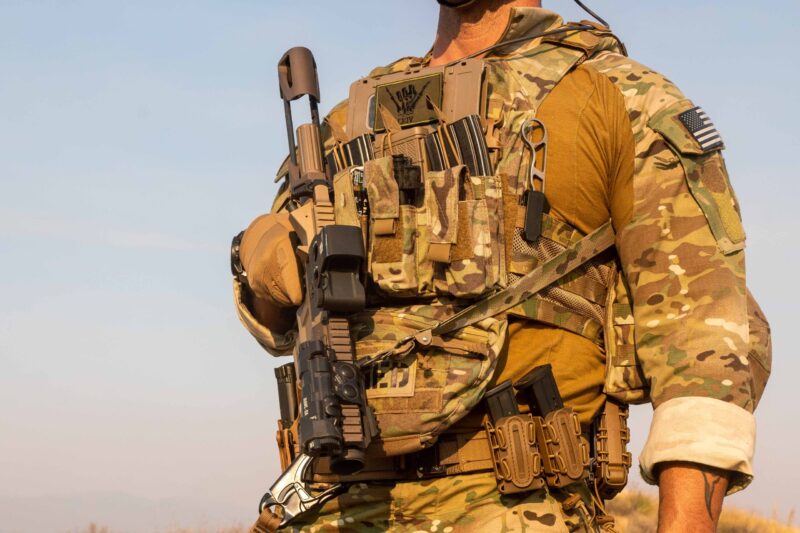
MOLLE (pronounced “Molly”) stands for Modular Lightweight Load-carrying Equipment. Introduced by the U.S. military in the late 1990s, it replaced the older ALICE system and fundamentally changed how soldiers and operators carry gear. MOLLE is not a single product — it is the entire load-bearing ecosystem, encompassing plate carriers, tactical vests, magazine pouches, dump pouches, utility pouches, backpacks, and every other modular accessory that attaches to a PALS-equipped surface.
The defining strength of the MOLLE system is its modularity. You can add, remove, or reposition pouches in minutes to meet mission requirements. A rig configured for a patrol looks completely different from one set up for a breaching operation or medical response — and MOLLE makes that reconfiguration fast and tool-free.
Key Features of MOLLE
- Modularity: Add or remove radio pouches, shotgun shell pouches, medical kits, magazine carriers, or dump pouches in seconds without tools.
- Customizability: The gear can be tailored for specific tasks, such as military operations, hiking, or hunting.
- Durability: MOLLE gear is designed for rugged use and made from high-quality materials like Cordura fabric, which is abrasion- and water-resistant.
- Compatibility: MOLLE systems are compatible with various platforms, from backpacks to body armor and tactical vests.
Disadvantages Of MOLLE
- Complicated Setup: Though MOLLE is highly flexible and customizable, it can be difficult to set up, especially for beginners. Learning to attach and reattach gear takes practice; under time pressure in the field, readjusting a rig adds friction.
- Weight and Bulk: MOLLE equipment can be cumbersome, particularly when heavily accessorized. The webbing itself, plus the pouches and their contents, quickly compound during long operations or extended hikes.
What Is PALS?
PALS, or the Pouch Attachment Ladder System, is a grid of webbing that allows MOLLE-compatible gear to be attached to any MOLLE-equipped surface. Often confused with MOLLE itself, PALS is the framework or infrastructure behind the modularity of MOLLE gear. The horizontal rows of stitched webbing you see on backpacks, plate carriers, chest rigs, and other tactical gear are the PALS system.
PALS was developed by the U.S. Army Natick Soldier Center and introduced in 1997 as part of the original MOLLE program. Today, it is standardized under military specifications A-A-55301 and MIL-W-17337.
• Webbing width: 1 inch (25.4 mm) — Mil-Spec nylon only
• Row spacing: Rows spaced exactly 1 inch (25.4 mm) apart, center-to-center
• Bar-tack intervals: Stitched to the backing at 1.5-inch (38 mm) intervals — this creates the individual attachment loops
• Stitching standard: Bar-tacked at each interval for maximum pull strength under load
• Specification references: A-A-55301 (commercial item description) / MIL-W-17337 (nylon webbing)
Key Features of PALS
- Grid Layout: Horizontal rows of 1-inch nylon webbing, bar-tacked at 1.5-inch intervals, creating consistent loops across the entire surface area of the platform.
- Attachment Points: The webbing serves as loops through which users can thread straps, cords, or buckles to secure MOLLE-compatible accessories.
- Strength: The reinforced stitching in PALS ensures attachments remain secure, even under heavy loads.
- Standardization: PALS webbing adheres to strict specifications, ensuring compatibility across manufacturers and gear.
Cons of PALS
- Limited Attachment Options: Although PALS works well as a webbing system, it does not attach gear itself and instead relies on external attachment methods, such as malice clips or straps. This limited ability to attach may not be the best in all situations, particularly in hurried or tactical roles where speed counts.
- Frequent-Use Durability Issues: Over time, the PALS webbing will wear and tear under unfavorable conditions. Repeated insertion and removal of MALICE clips gradually stress the bar-tack stitching. Budget gear using non-Mil-Spec webbing may experience loop failure earlier than expected.
From ALICE to MOLLE: A Brief History
Before MOLLE, the U.S. military used the ALICE system (All-purpose Lightweight Individual Carrying Equipment), adopted in 1973. ALICE used metal slide keepers commonly called ALICE clips to attach pouches to a pistol belt. While more durable than earlier canvas systems, ALICE had real problems: poor weight distribution, floppy pouch positioning, and highly limited configurability.
In the late 1980s, the Army attempted to address these shortcomings with the Individual Integrated Fighting System (IIFS), but field reports found its internal-frame pack unstable and uncomfortable in combat. These failures drove the development of a fundamentally new approach to load-bearing.
MOLLE entered limited service in 1997 and saw rapid widespread adoption after 9/11, as the operational tempo of the Global War on Terror demanded more configurable, mission-specific loadouts that soldiers could adapt in the field. Today, MOLLE and PALS are the global standard adopted by NATO allies, law enforcement agencies, and the civilian tactical and outdoor markets worldwide.
How MOLLE and PALS Work Together

Think of PALS as the socket and MOLLE as the plug. PALS provides the standardized grid of loops; MOLLE accessories provide the straps that thread through those loops to lock the gear in place. Together, they create a system that is simultaneously bombproof under load and endlessly reconfigurable between missions.
Here’s how they work together:
- PALS Webbing as the Foundation: The PALS webbing provides the attachment points. This grid of loops is found on backpacks, tactical vests, and belts.
- MOLLE Attachments: The pouches, holsters, or accessories you want to attach are part of the MOLLE system. These components have straps, clips, or cords designed to weave through the PALS webbing.
- Weaving Process: To secure an accessory, the straps on MOLLE gear are woven in and out of the PALS webbing, creating a tight bond that ensures the attachment won’t come loose easily.
- Versatility: This weaving system lets you attach multiple pieces of gear in various configurations to suit your needs.
- Test before use: Tug the accessory firmly in all directions. A correctly attached MOLLE pouch should not shift, rotate, or pull free under reasonable force.
The interplay of these two systems creates an efficient and reliable way to carry essential tactical tools without compromising on speed, flexibility, or durability.
The Differences Between MOLLE and PALS
Although MOLLE and PALS are interconnected, they are not the same thing. The distinction is subtle but important, especially when discussing gear compatibility and functionality.
1. Scope and Function
MOLLE refers to the entire modular load-bearing system, encompassing the platform and the various pouches, bags, and accessories. PALS is the webbing system that allows MOLLE gear to be attached to various surfaces. Saying “my rig is MOLLE” describes the whole ecosystem. Saying “my carrier has PALS webbing” describes the specific attachment interface on the platform surface. Without PALS, MOLLE gear wouldn’t have the versatile attachment points it’s known for.
2. Role in Customization
MOLLE: The MOLLE system’s strength lies in its wide array of attachments and accessories, from magazine pouches to medical kits. The modular design allows you to configure your gear to suit your mission.
PALS: PALS is the standardized attachment mechanism, the foundation that enables customization, but it doesn’t provide customization on its own. PALS is static; MOLLE is what you adapt.
3. Compatibility and Standardization
MOLLE: MOLLE systems are designed to be compatible across various platforms. Whether you’re attaching gear to a vest, tactical backpack, or belt, the MOLLE system ensures everything stays in place.
PALS: PALS webbing is fully standardized under mil-spec dimensions (1-inch webbing, 1.5-inch bar-tack intervals). Because those dimensions are open and universal, MOLLE-compatible accessories from any manufacturer — Chase Tactical, other U.S. makers, or allied-nation suppliers — will fit any PALS surface that meets the specification.
4. What You Buy vs. What It Mounts On
When you purchase a plate carrier or chest rig, you are buying a PALS-equipped platform. When you purchase magazine pouches, utility pouches, or a radio pouch, you are buying MOLLE-compatible accessories. The two are designed for each other; neither is complete without the other.
Traditional PALS vs. Laser-Cut MOLLE Platforms
Traditional PALS uses individual 1-inch nylon straps sewn onto a fabric backing — the classic “ladder” look you see on most plate carriers and chest rigs. A newer variation, often called laser-cut MOLLE or a laser-cut platform, cuts the webbing grid directly into a single sheet of laminated material using precision laser cutting.
- Weight: Laser-cut platforms are significantly lighter — no extra stitched webbing straps or overlapping fabric layers at attachment points.
- Profile: Laser-cut carriers sit flatter with a cleaner, more modern look. No raised webbing rows to snag on obstacles or brush.
- Durability: Traditional stitched PALS webbing is extremely durable under heavy loads and repeated use. Laser-cut edges on budget laminates can fray over time if not properly sealed.
- Compatibility: Both accept the same MOLLE-compatible accessories as long as the slot dimensions meet the 1-inch standard.
For most military and law enforcement applications, traditional stitched PALS remains the benchmark. Laser-cut platforms are popular for lightweight builds, training rigs, and civilian use where reducing weight and profile is the priority.
How To Use MOLLE and PALS Correctly
Understanding how to use MOLLE and PALS properly is crucial for maximizing the functionality of your gear. Here’s a step-by-step guide to attaching MOLLE pouches to PALS webbing:
- Choose Your Gear: Select the MOLLE pouch or accessory you want to attach to your PALS-equipped gear.
- Align the PALS Webbing: Line up the straps on your MOLLE accessory with the PALS webbing on your platform (backpack, vest, etc.).
- Weave the Straps: Begin weaving the attachment straps in and out of the PALS webbing to ensure a tight, secure fit. This creates a strong bond between the accessory and the platform.
- Secure the Attachment: Once fully woven, use snaps, buckles, or Velcro to secure the straps. Make sure everything is tight to prevent movement during use.
- Test the Attachment: Before heading out, test the attachment’s stability by tugging on the accessory. It should feel secure and immovable.
Which System Is Right for You?
MOLLE and PALS are not competing choices — every MOLLE setup requires a PALS platform. But how you configure that platform varies significantly by use case:
- Military / combat operations: Full MOLLE loadout on a plate carrier with hard armor — magazine pouches, medkit, dump pouch, admin pouch, radio pouch. Maximum configurability and load capacity.
- Law enforcement: Chest rig or duty vest with PALS webbing — fewer accessories, faster access. Typically a magazine carrier, medkit, and utility or handcuff pouch.
- Hunters and outdoor enthusiasts: PALS-equipped pack with a lightweight MOLLE accessory kit — hydration carrier, medkit, and one or two utility pouches. Weight management is the priority.
- Home and emergency preparedness: A compact PALS backpack with modular medical and utility pouches — easy to customize as needs change without replacing the bag.
Why MOLLE and PALS are Important for Tactical Gear
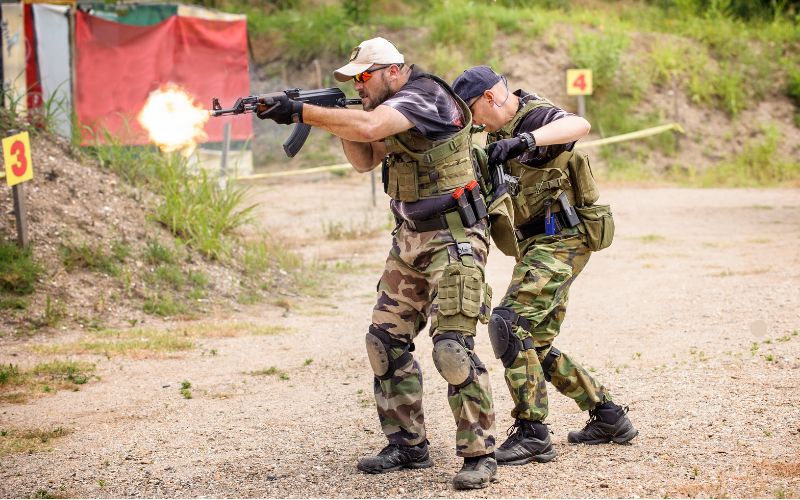
MOLLE and PALS are fundamental in providing the flexibility, strength, and durability that modern tactical gear requires. Here’s why they matter:
- Mission-Specific Loadouts: MOLLE allows you to tailor your gear to the specific task at hand, whether you’re in a combat zone, on a hike, or working in law enforcement.
- Durability: The PALS webbing system ensures that your attachments stay secure even under tough conditions, offering reliability when it matters most.
- Compatibility Across Gear: Whether you mix and match brands or stick to one manufacturer, PALS ensures your MOLLE-compatible gear will work seamlessly together.
Conclusion
MOLLE and PALS are two sides of the same system. PALS is the standardized webbing grid of 1-inch nylon webbing, bar-tacked at 1.5-inch intervals per mil-spec A-A-55301, that provides a universal attachment interface. MOLLE is the broader ecosystem of modular pouches, holsters, carriers, and accessories that mount to that grid. Together, they provide soldiers, operators, and civilians with a load-bearing platform that can be configured, reconfigured, and scaled for any mission or activity.
Understanding the distinction makes you a more informed buyer. When you select a plate carrier or chest rig, you are choosing a PALS platform. When you select magazine pouches, medkits, or utility pouches, you are building out your MOLLE loadout. Get the platform right, and the rest of your kit follows.
Frequently Asked Questions
Can I use MOLLE gear without PALS webbing?
No, MOLLE gear relies on the PALS webbing system for attachment. Without PALS, there would be nowhere to attach MOLLE-compatible pouches or accessories.
Is PALS webbing exclusive to military gear?
While PALS webbing was initially developed for military use, it’s now widely used in civilian applications such as hiking, hunting, and law enforcement.
Are all MOLLE and PALS systems compatible across brands?
Yes, PALS webbing is standardized, so MOLLE-compatible gear from different manufacturers should work together if they follow the same specifications. Budget gear that cuts corners on the spec may have fit or durability issues.
What is a MALICE clip, and how is it different from a strap?
A MALICE clip is a rigid nylon or polymer rod that threads through PALS webbing loops in place of a fabric strap. It locks the accessory in place without the weaving step, allowing for faster attachment and removal. It is a common alternative to strap-based attachment on MOLLE pouches, particularly for operators who need to swap gear quickly.
Why is MOLLE more adaptable than PALS?
MOLLE encompasses the entire modular ecosystem, including PALS webbing, MALICE clips, and the full library of compatible accessories. The modular approach means you can reconfigure a loadout for a completely different mission without replacing the base platform. PALS is a fixed interface; MOLLE is the flexible system built around it.
What is laser-cut MOLLE?
Laser-cut MOLLE (also called a laser-cut platform) is a newer manufacturing method where the webbing grid is cut directly into a single laminated fabric sheet rather than stitching individual nylon straps onto the backing. It produces a lighter, flatter carrier but may be less durable than traditional stitched PALS webbing under heavy, sustained loads.
Is it possible to use PALS without MOLLE?
PALS is the fundamental design of the MOLLE system. Although you could technically have PALS webbing on a carrier without mounting any MOLLE accessories, you would lose all the efficiency and versatility of the full system. The webbing exists to accept MOLLE attachments. Without them, it is simply decorative stitching.