








Modern Body Armor Trends & Innovations


Modern body armor has entered a new era defined by lighter materials, smarter designs, and adaptive technology. From graphene-enhanced plates to thermally regulated carriers, today’s innovations are reshaping how protection, comfort, and mobility coexist — for military personnel, law enforcement, and civilians alike. Whether you’re shopping for ballistic plates or looking to upgrade your loadout, understanding the latest advancements will help you make the right call.
Thermal Regulation Technologies
Thermal regulation is one of the most impactful advancements in modern body armor. Phase-change materials (PCMs) absorb excess body heat and gradually release it, helping maintain a stable temperature during prolonged wear. Outlast® PCM technology, originally developed by NASA, can regulate temperature for up to 14 hours across varying conditions.
Complementing PCMs, moisture-wicking fabrics, and engineered mesh enhance airflow and channel heat away from the body without requiring any power source. Reflective thermal inserts provide additional protection against radiant heat, reducing physiological strain during high-intensity operations.
For environments that demand more aggressive cooling, active systems provide powered solutions. Micro-ventilation channels, liquid-cooled inserts, and micro-fans prevent overheating, ensuring optimal endurance and performance under sustained physical stress.
Material Innovations in Armor Design
Lightweight Ceramic Composites
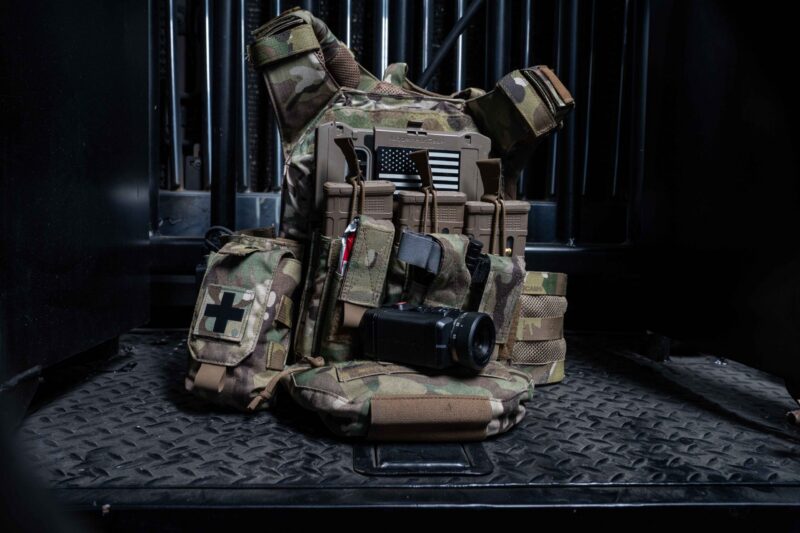
Lightweight ceramic composites — including boron carbide, silicon carbide, and aluminum oxide — are redefining the balance between protection and agility. Plates weighing under 4.00 lbs improve maneuverability without sacrificing ballistic performance, with V50 values exceeding 4,000 ft/s to withstand high-velocity rifle and armor-piercing threats. To understand how these materials compare across protection levels, see our Level III and Level IV body armor guide.
Manufacturing techniques such as hot pressing and sintering minimize porosity, producing durable, lightweight plates. Multilayered composite configurations allow designs to adapt to evolving ballistic challenges while integrating seamlessly with existing production methods.
Ready to upgrade your plates? Browse our full selection of NIJ-certified ballistic plates — lightweight ceramic, UHMWPE, and composite options built for real-world performance.
Graphene-Enhanced Protection Layers
Graphene — 200 times stronger than steel and harder than diamond — is emerging as one of the most promising materials in armor design. Its unique combination of stiffness and elasticity offers a 15–20% weight reduction compared to traditional armor without compromising protection.
Unlike conventional ceramic armor, graphene-enhanced plates can withstand three times as many hits before failure, effectively dispersing stress to minimize trauma. Its thermal stability ensures reliable performance under extreme conditions. These properties have driven integration into military, law enforcement, school, and embassy applications, including bulletproof clothing and NIJ-certified hard plates.
Ergonomic Designs for Enhanced Comfort
Female-Specific Armor Solutions
Standard body armor has historically failed to accommodate female anatomy, creating fit gaps and discomfort that affect both protection and performance. Modern female-specific solutions address this through contoured panel designs with lateral darts and dome-formation techniques that eliminate gaps without compressing the chest. Padded liners and smooth panel edges distribute pressure evenly, while adjustable, padded shoulder straps accommodate narrower widths and ensure proper weight distribution. These refinements improve both safety and confidence for female officers in the field.
Flexible Body Armor Designs
Flexible steel fiber meshes, ceramic-composite matrices, and materials like Kevlar and Dyneema are enabling body armor that conforms to natural movement. Anatomic assault vests molded from clamshell HD-PE composites eliminate hot spots and adapt to individual body shapes, while pressure sensor systems ensure even coverage. Flexcore technology and form-fitting vests with elastic side harnesses further reduce fatigue during extended wear, redefining comfort without compromising protection. Pairing your armor with the right plate carrier is key to maximizing both fit and performance.
Modular Systems for Versatile Protection
Modular systems give operators the flexibility to scale protection based on mission requirements. The M.U.S.T. system offers over 30 interchangeable components that transform a lightweight plate carrier into comprehensive torso-to-groin protection, with soft and hard inserts. The Storm system enables quick upgrades from a standalone plate to advanced protection against threats like .30-06 APM2. Modular Scalable Vests combine quick-release features with improved weight distribution, replacing older platforms with better coverage and comfort across varied operational environments. Maximize your modular setup with purpose-built plate carrier accessories designed for professional operators.
A modular setup is only as good as the carrier it’s built on. Shop our plate carriers designed for quick reconfiguration, optimal weight distribution, and full MOLLE compatibility.
Advances in Manufacturing Processes
3D printing now enables complex, custom-fit geometries that optimize energy absorption tailored to individual users. Advanced fiber production — particularly Dyneema — delivers a higher strength-to-weight ratio without requiring retooling, making armor lighter and more resilient. CoreMatrix technology disperses impact energy uniformly, improving ballistic performance while streamlining production with fewer SKUs. Custom body-scanning ensures a precise fit, reducing coverage gaps, while nanocomposite coatings containing graphene oxide and nanoparticle silica enhance fabric resilience and pliability. For a detailed breakdown of how materials stack up, explore our ceramic vs. steel plates comparison.
The Role of Smart Fabrics in Modern Armor

Smart fabrics represent a significant leap in both protection and real-time functionality. Conductive carbon nanotube networks woven into Kevlar detect the force and location of impacts — similar to touchscreen technology — enabling automated alerts in high-risk situations. Shear-thickening fluids (STF) and shear-stiffening polymers provide adaptive protection, hardening instantly on impact to dramatically increase ballistic resistance. Lightweight nanomaterials reduce vest weight by up to 40%, improving mobility and reducing fatigue without compromising strength. According to NIJ’s compliant products list, certified armor must meet rigorous performance thresholds — smart material innovations are increasingly helping manufacturers meet and exceed those standards.
Award-Winning Innovations
Several recent innovations have set new industry benchmarks. Logistik Unicorp’s Women’s Armour System — winner of the 2026 Body Armor Innovation Award — uses 3D anthropometric scanning to tailor armor to female body forms. Australian Defence Apparel’s ENFORCR® H.A.L.O. X Carrier introduces laser-cut MOLLE and climate-regulating padding for enhanced operational comfort. Bodyguard’s Switchblade Deployment System converts a backpack into a protective vest in under 2 seconds, making it ideal for rapid-response scenarios. The Ace Link Armor Thermacore® System rounds out recent accolades with its passive thermal regulation through engineered materials — no electronics required. To explore how today’s body armor protection levels are defined and tested, Chase Tactical’s breakdown covers everything you need to know.
Conclusion
Body armor technology is advancing faster than ever, driven by breakthroughs in materials science, manufacturing, and ergonomic design. Graphene composites and lightweight ceramics are raising the bar for ballistic performance, while smart fabrics and thermal regulation systems ensure wearers stay comfortable and mission-ready in demanding conditions. Modular systems and custom-fit manufacturing mean protection is no longer one-size-fits-all — it’s tailored to the individual and adaptable to the threat. As these innovations continue to mature, the future of body armor points toward gear that is lighter, smarter, and more protective than anything available today.
Frequently Asked Questions
How does modern body armor impact mobility?
Modern body armor can restrict shoulder movement and affect balance and postural control. Heavier or poorly fitted systems increase the risk of compensatory movement patterns that place additional stress on joints and muscles over time.
Is modern body armor effective against non-ballistic threats?
Yes. Advanced materials like graphene and carbon nanotubes enhance resistance to stab threats, fragmentation, and in some applications, chemical or biological hazards — extending protection beyond traditional ballistic-only designs.
How does modern body armor accommodate different body types?
Current designs feature adjustable straps, contoured panels, modular components, and custom-fit scanning to ensure proper coverage and comfort across a wide range of body types and sizes.
What are the potential drawbacks of advanced armor materials?
Some advanced materials can be fragile, degrade over time, or underperform in extreme environmental conditions. Certain composites may also have limited multi-hit performance, which remains an active area of development.