








China’s New Ship May Be the First Submarine Drone Mothership

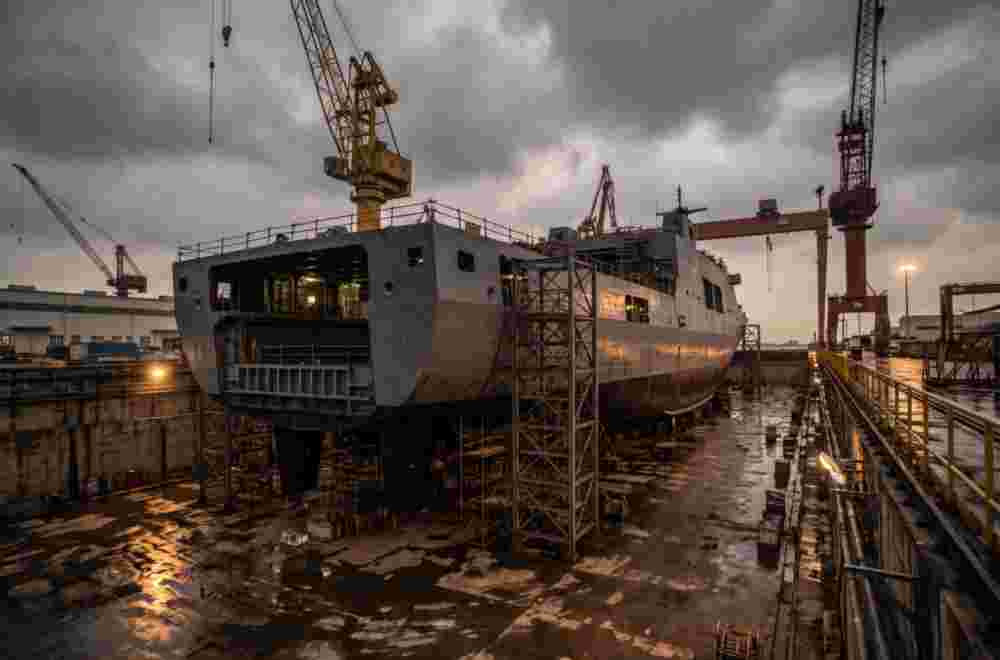
Commercial satellite imagery of the Hudong-Zhonghua shipyard in Shanghai has revealed an unusual vessel that open-source naval analysts assess is very likely the world's first purpose-built mothership for giant uncrewed submarines. Naval News analyst H.I. Sutton, who first reported the find on September 15, concluded the roughly 200-meter hull is most plausibly a dedicated support ship for China's XXLUUVs, or extra-extra-large uncrewed underwater vehicles, rather than a civilian or research vessel, based on an internal hangar and a stern well-deck design with no obvious commercial application.
The ship was first flagged publicly on September 13 by a Japanese open-source satellite analyst posting as KAROTASU, who described a roughly 200-meter, 30-meter-beam vessel resembling a roll-on/roll-off cargo ship under construction in a 340-meter-class dry dock, noting unusual pole-like fittings and partially assembled structures whose purpose wasn't clear from the imagery alone. That early spotting was quickly picked up and analyzed in depth by defense specialists, who connected the unusual hull features to China's known uncrewed submarine program.
現在340m級ドックでは詳細不明船舶が建造中。全長約200m、全幅約30m程度でRORO船のような船型。船体は多層デッキ構造になっている模様だが、自動車運搬船などでみられる船尾スターンランプなどは確認出来ない。船体上部には目的不明のポールのようなものが設置、ドック内でも詳細不明構造物が組立中 https://t.co/alzsr6gS5G pic.twitter.com/7N1rdwhaKn
— KAROTASU (@type36512) September 13, 2026
According to Sutton's assessment, the vessel's stern well-deck sits open beneath the ship, with a large cradle that can be lowered into the sea on twelve vertical jack-up arms, while an enclosed hangar forward of the well-deck could plausibly house up to four of China's largest underwater drones. That arrangement would be a significant upgrade over the specialized floating docks China has used until now to transport and launch its existing XXLUUVs, two of which have been observed undergoing testing near Hainan at an estimated 35 and 45 meters long, making them six to eight times the size of the U.S. Navy's Boeing Orca XLUUV.
The Naval News assessment did not stand alone for long. The South China Morning Post reported on September 18 that a separate military imagery analyst, reviewing satellite photos of the same dry dock taken September 10, independently identified an apparent stern launch-and-recovery system and a lifting cradle positioned behind the ship, calling the mothership explanation credible. Trade outlet Interesting Engineering additionally reported that The Telegraph had corroborated the find using satellite imagery from Vantor, a U.S. defense intelligence contractor, and that the vessel may also carry a separate aviation hangar near the bow capable of housing a helicopter.
Beijing has not commented on the vessel's purpose, and no U.S. government agency has issued a public assessment or response to the reporting. Every figure in circulation, including the ship's dimensions, drone capacity, and possible missions, comes from private-sector satellite imagery analysis rather than any official confirmation, and analysts caution that the vessel's final propulsion, sensors, and operational status can't be determined from overhead photos alone.
China has already distinguished itself as the only country to test full-sized uncrewed submarines, but its XXLUUV program has so far depended on shore-based floating docks that tie testing to a handful of fixed locations. A mobile mothership would let Beijing service, launch, and recover the giant drones far from those facilities, extending their practical range and endurance in a way that static infrastructure cannot. Naval News assessed that the drones could plausibly support long-range missions, including deployment off the U.S. West Coast during a period of heightened tension, though that scenario remains speculative given how little is publicly known about the XXLUUVs' actual payloads or mission sets.
Analysts contacted by Interesting Engineering floated a range of possible missions for the underwater drones themselves, including intelligence, surveillance and reconnaissance, seabed monitoring, and mine warfare, while cautioning that none of it has been confirmed by Beijing. The uncertainty cuts both ways: the mothership could just as easily be intended for benign testing and research support as for an operational combat role, and commercial satellite imagery cannot resolve that question on its own.
The following is analysis, not confirmed fact. For a U.S. defense and special operations audience, the more significant story may not be this single ship but the pattern behind it: China is the only country currently fielding uncrewed submarines at this scale, and a dedicated mothership suggests Beijing intends to move the program from experimentation toward sustained operations. The U.S. Navy's own XLUUV effort, the Boeing Orca, is a fraction of the size of China's largest tested drones and has no comparable purpose-built support ship in the fleet today. That gap matters most in a seabed-warfare and undersea-ISR context, where China's growing willingness to invest in unconventional platforms could complicate American assumptions about who controls the undersea domain in a future Indo-Pacific contingency. It does not, on the evidence available now, indicate an imminent operational threat, since the ship remains under construction and the drones it would carry have no demonstrated combat history.
A single unusual hull in a Shanghai dry dock has, through methodical open-source analysis rather than any government disclosure, offered one of the clearest windows yet into where China's uncrewed submarine program is headed. Absent an official statement from Beijing or Washington, the ship's construction over the coming months will be the best available indicator of whether this is the first operational mothership of its kind or something more limited than analysts currently suspect.