








Hook and Loop Vs Bungee Mag Pouches: a Practical Guide

Magazine pouch retention is one of the most consequential and least discussed decisions in building a plate carrier loadout. The system you choose determines how quickly you can reload, how securely your magazines are held during dynamic movement, and how well your gear holds up in the specific environmental conditions of your mission. Hook-and-loop and bungee retention represent two distinct design philosophies, each with clear strengths and specific trade-offs. This guide breaks both down in practical terms so you can make the right call for your role, environment, and operational tempo.
How Hook-and-Loop Retention Works
Hook-and-loop retention uses a two-part fastening system: a hook side with small, firm teeth that grip a soft loop surface, holding a flap closed over the magazine. When you pull the flap open, the bond releases; when you close it, the system reseats automatically. This self-reattaching behavior is one of its most operationally relevant features. After a reload, the flap closes on its own without any deliberate action from the operator, which means your magazine is re-secured without conscious effort between engagements.
Key Advantages
- Automatic re-retention: The flap reseats itself after a reload with no deliberate action; your magazine is re-secured without thinking about it.
- Debris and moisture protection: The covered magazine well resists dirt, mud, and water ingress, which can cause feeding malfunctions under field conditions.
- Long service life: High-density, MIL-Spec hook fields are rated for tens of thousands of cycles without meaningful grip loss, significantly longer than bungee cords under comparable use.
- Jumpable compatibility: On carriers with elastic cummerbund systems, the cummerbund can overlap the pouch top for additional security during airborne operations.
The main trade-off is draw speed. Accessing a magazine requires lifting or pulling back the flap before the magazine can be retrieved. For operators for whom controlled reloads matter more than fractional-second draws, that extra motion is a worthwhile trade-off for the added security. For a broader overview of pouch types and how to evaluate them, see our guide to choosing the right mag and ammo pouch.
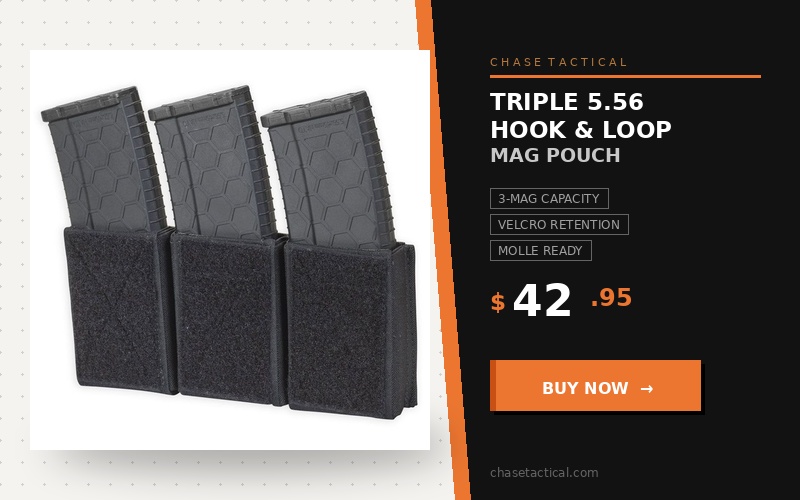
The Chase Tactical Triple 5.56 Hook & Loop Mag Pouch is built for this application. It attaches to the front loop field of a plate carrier via hook-and-loop, with no MOLLE threading required, and holds three 30-round 5.56mm magazines using double-layer MIL-Spec elastic with non-slip interior lining. The cummerbund on compatible carriers can overlap the top of the pouch, creating a jumpable configuration suited for airborne operations. It is designed to integrate natively with the Chase Tactical LVPC line and is backed by a limited lifetime warranty.
How Bungee Retention Works
Bungee retention uses an elastic cord threaded through the pouch to apply constant inward pressure against the magazine body, holding it in place without a covering flap. To retrieve the magazine, you pull against the bungee tension, it releases, and the cord snaps back into position. There is no flap to open and no cover to reseat, making bungee systems inherently faster for open-top access.
Key Advantages
- Faster draw speed: No flap to open the magazine; the magazine is retrieved in a single motion with fewer fine-motor steps, which matters under stress.
- Simpler reload sequence: Open-top access reduces the cognitive and physical steps involved in reloading, improving consistency under pressure.
- Adjustable tension: Bungee cord tension can be tuned to fit different magazine body widths and retention preferences.
Key Limitations
- Retention degrades over time: Bungee cords lose elasticity with repeated use and exposure to heat, UV, and moisture a cord that holds firmly when new may develop slack after extended use.
- Less debris protection: Open-top designs leave the magazine well exposed to dirt, mud, and moisture in field conditions.
- Requires periodic inspection: Cord tension should be checked regularly and replaced as elasticity degrades to maintain reliable magazine retention.
Bungee systems work well in controlled or semi-controlled environments where conditions are predictable and speed is the primary priority: competition shooting, range training, and vehicle-based operations where the carrier is not subject to sustained physical impact or exposure to debris. According to NIJ equipment performance guidance, tactical gear reliability must account for environmental degradation over the product’s service life — a standard that applies directly to retention system choices.
Speed and Accessibility
In a direct speed comparison, open-top bungee configurations consistently allow faster magazine retrieval than hook-and-loop flap designs. The absence of a flap means the draw motion is simpler and requires fewer fine motor movements an important consideration in high-stress situations where fine motor skills degrade. For competitive shooting or scenarios where split-second reloads directly determine outcomes, bungee or open-top elastic designs have a clear edge.
That said, speed is only one dimension of accessibility. A system that allows faster draws but loses magazines during movement or fails in wet conditions is not operationally faster it is a liability. For tactical and law enforcement applications where the carrier is subject to running, climbing, vehicle entry and exit, and extended field use, the additional security of a hook-and-loop flap often outweighs the speed advantage of open-top bungee access. The right choice depends on where your mission falls on the speed-versus-security spectrum. For environment-specific loadout guidance, see our plate carrier setups for different environments guide.
Material and Construction Quality
Hook-and-Loop Pouch Materials
500D Cordura nylon is the industry benchmark it offers superior abrasion resistance, maintains its shape under sustained load, and resists the moisture and field conditions that degrade lower-grade fabrics over time. The hook-and-loop field itself should be densely woven and reinforced at the edges, where separation stress is highest. Low-density hook fields lose their grip over time; tightly woven, high-density fields maintain strong retention throughout the pouch’s service life.
Bungee System Materials
The cord material determines service life. Synthetic elastomers with polyester or Dyneema sheaths offer better UV and abrasion resistance than natural rubber cores. Marine-grade shock cords extend this further with chemical and oil resistance, which matters for vehicle-based operations.
Regardless of retention type, bar-tacked stress points at all MOLLE attachment rows, flap hinges, and retention anchor points are the most reliable indicators of overall construction quality. These are the locations that fail first under sustained load, and reinforcement here directly extends the pouch’s usable life. For more on how MOLLE attachment systems work across a full plate carrier setup, see our guide to MOLLE-compatible plate carriers.
Choosing the Right System for Your Mission
Choose Hook-and-Loop If:
- You operate in field environments with exposure to mud, rain, dust, or debris
- Your mission involves sustained physical movement running, climbing, vehicle entry, and exit
- Controlled, reliable reloads matter more than fractional-second draw speed
- You need a jumpable configuration for airborne operations
- Your carrier has a front loop field designed for hook-and-loop attachment
Choose Bungee If:
- The speed of magazine access is the primary performance metric
- You are in a competition, training, or range environment where conditions are predictable
- The carrier is not subject to extended hard movement or debris exposure
- You are comfortable with periodic cord tension inspection and replacement
Many operators run both systems on the same carrier hook-and-loop for primary rifle magazine pouches on the front panel, and bungee or open-top retention for pistol magazines or secondary pouches on the cummerbund where faster draw access is needed. This hybrid configuration captures the security benefits of flap retention where it matters most while keeping the fastest access points open for secondaries. For a complete guide on configuring your plate carrier pouch layout, see our guide to choosing plate carrier accessories for missions.
Conclusion
The choice between hook-and-loop and bungee retention is not about which system is objectively better it is about which system is better matched to your specific use case. Hook-and-loop delivers superior security, automatic re-retention, and environmental protection at the cost of a slightly slower draw. Bungee delivers faster open-top access with less debris protection and a retention profile that requires more maintenance over time. Both have legitimate applications and are valid components of a well-configured tactical loadout, depending on where they are placed and the role they serve.
What matters most is that the choice is deliberate rather than default. Too many operators select a pouch based on what came with their carrier or what looked familiar rather than what suits their actual mission environment. Evaluate your operational tempo, the conditions you work in, and how frequently you need to execute fast reloads versus how critical it is that your magazines stay put during extended movement. Get that decision right, and the rest of your loadout configuration follows naturally.
Frequently Asked Questions
How do weather conditions affect mag pouch performance?
Moisture and humidity are the primary concerns. Hook-and-loop flaps protect magazine wells from water and debris ingress, which matters for field reliability wet or contaminated magazines can cause feeding malfunctions. Bungee systems leave the magazine exposed at the top, making them more susceptible to debris in dusty or muddy environments. For sustained outdoor operations, hook-and-loop offers better all-weather protection. In dry, controlled environments, bungee systems perform reliably without this trade-off.
What is the average lifespan of each pouch type?
A quality hook-and-loop pouch built from 500D Cordura with a high-density hook field is rated for approximately 20,000 closure cycles before meaningful loss of retention. Bungee retention lifespan depends heavily on cord quality and usage conditions standard elastic cords can degrade within 1–3 years under regular use and UV exposure, while synthetic elastomer cords with Dyneema or polyester sheaths extend this significantly. In both cases, regular inspection of the retention system is the best way to catch degradation before it affects reliability.
Can I run both systems on the same plate carrier?
Yes, and many operators do. A common configuration uses hook-and-loop pouches for primary rifle magazines on the front panel where security and debris protection are highest priority and open-top or bungee retention for secondary pouches on the cummerbund or sides where faster draw access matters more. This hybrid approach captures the strengths of both systems and is a practical solution for operators who need both speed and security in different areas of their kit.
Does pouch retention type affect overall gear weight?
Marginally. Hook-and-loop pouches typically carry slightly more material weight due to the flap structure and additional hook-and-loop field. Bungee and open-top designs eliminate that material, reducing weight by a small amount per pouch. Across a full loadout, the difference is minimal and should not be a primary factor in the decision. Material construction, Cordura weight, hardware quality, and MOLLE webbing density have a more significant impact on overall pouch weight than retention type alone.