








CENTCOM Chief Says Hormuz Campaign Reached Its Limit

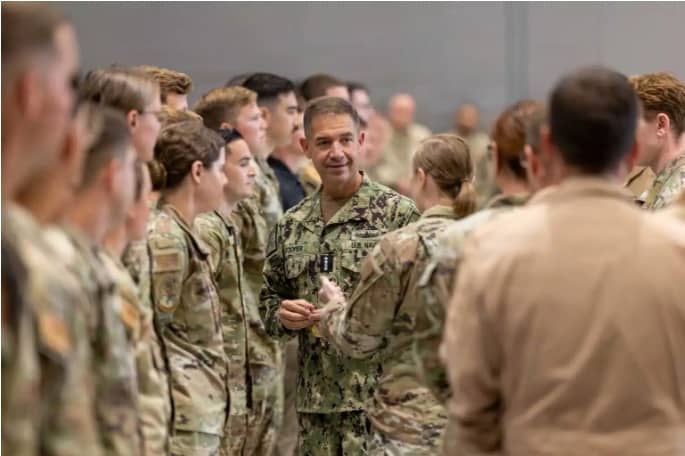
Adm. Brad Cooper, the commander of U.S. Central Command (CENTCOM), advised the Pentagon, Joint Chiefs of Staff, and White House that nearly two weeks of sustained strikes had brought the bombing campaign around the Strait of Hormuz to the limit of its effectiveness, with most designated targets already exhausted, Axios reported Sunday.
The assessment was a central factor in President Donald Trump’s decision on July 25 to pause strikes against Iran.
Cooper told senior officials that continuing airstrikes would produce diminishing returns without a substantially larger escalation of the conflict, two sources familiar with his position told Axios.
The recommendation identified a strategic ceiling. The air campaign had significantly degraded Iran’s ability to threaten commercial shipping through the 21-mile-wide chokepoint but could not compel the strait’s reopening without an expansion of military operations that Trump’s advisers were not prepared to support.
Vice President JD Vance and Joint Chiefs Chairman Gen. Dan Caine separately raised concerns about munitions stockpile sustainability and escalation risks during White House discussions, CNN reported. The alignment of target exhaustion with materiel strain gave the president’s senior team a unified case for stopping operations.
The U.S. campaign, which began July 7 after Iran attacked merchant vessels in the strait, has paused for three consecutive days. Iran’s retaliatory strikes on Gulf infrastructure stopped in parallel.
The U.S. naval blockade against Iran remains in full effect. As of July 25, CENTCOM has redirected 12 commercial vessels trying to run the blockade, disabled 2 that didn't comply, and boarded 2 to ensure total compliance.
— U.S. Central Command (@CENTCOM) July 25, 2026
Earlier today, U.S. forces completed a verification… pic.twitter.com/eyp1N2B9sO
Qatar- and Pakistan-led mediators are working to revive a collapsed ceasefire, the Associated Press reported. Iran and Oman are in separate talks focused on reopening the strait’s middle passage to commercial traffic. Shipping through Hormuz has fallen to a three-week low.
A U.S. sailor stands watch aboard USS Frank E. Petersen Jr. (DDG 121) as the ship patrols the Arabian Sea supporting the U.S. blockade against Iran. CENTCOM has redirected 17 commercial vessels, disabled 2, and boarded 2 to ensure compliance. pic.twitter.com/O20NSE3dTP
— U.S. Central Command (@CENTCOM) July 27, 2026
U.S. Ambassador to the United Nations Mike Waltz told Fox News that Trump was “giving talks some space.”