







Marine Lance Corporal 3D-Prints $10 Fix for a $5,600 Antenna Mast

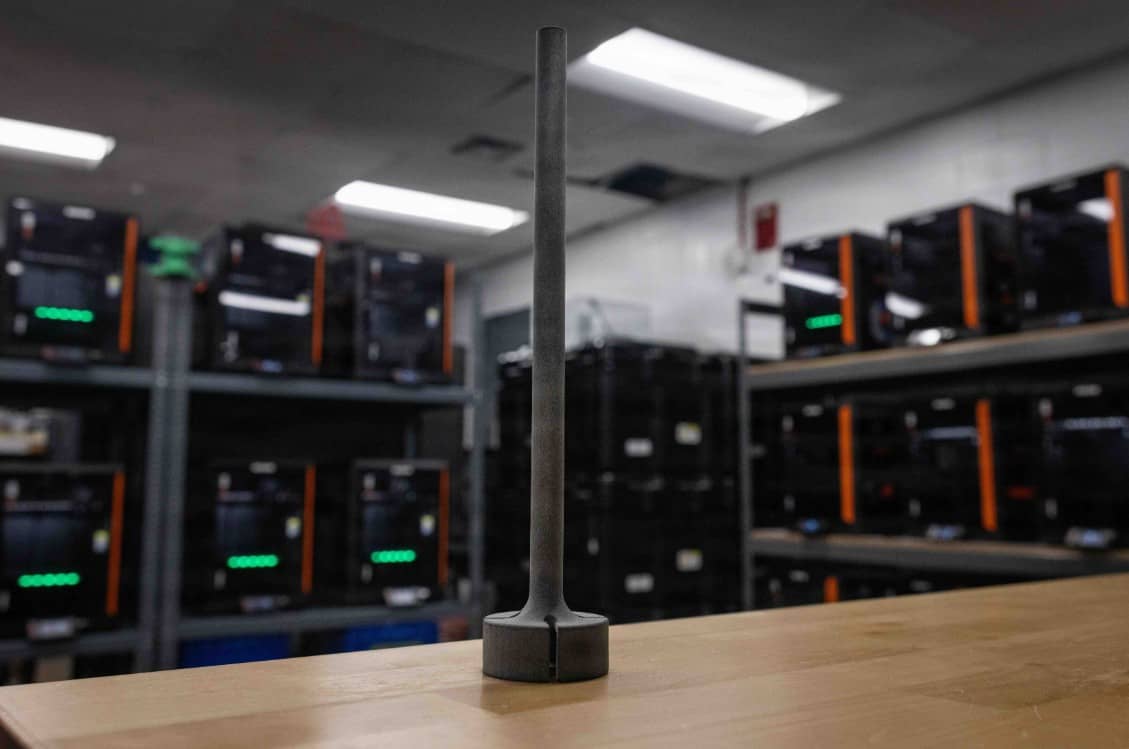
A U.S. Marine has developed a 3D-printed replacement for a commonly broken antenna mast used in a key military communications system, significantly reducing costs and supply delays across multiple units.
In a news release, the Marine Corps said Lance Cpl. Eirick Schule, an engineer equipment operator with 2nd Distribution Support Battalion, Combat Logistics Regiment 2, 2nd Marine Logistics Group, developed a replacement for the Mobile User Objective System (MUOS) antenna mast in April 2025 while assigned to the II Marine Expeditionary Force (MEF) Innovation Campus, after identifying a recurring issue with damaged masts.
The original fiberglass mast, prone to breaking from repeated use and environmental exposure, had rendered dozens of antennas unusable. Chief Warrant Officer 3 Matthew Pine estimated the worth of damaged masts across the Marine Corps at more than $1 million.
“I went to a joint exercise in April 2025, and we looked at how many of these pieces were broken across the Marine Corps, and it was over one million dollars’ worth,” said Pine. “Since then, the II MEF Innovation Campus has taken more of an initiative in seeking out problems and helping other units with supply issues.”
Schule, who enlisted in the Marine Corps in 2022 and had prior experience as a CNC machinist, had only recently completed a basic additive manufacturing course at Camp Lejeune when he tackled the problem. Drawing on his background, he reverse-engineered the fragile fiberglass component and used 3D printing to create a more durable alternative. Initial prototypes faced durability challenges, but Schule refined the design by optimizing print orientation and settings, resulting in a stronger, reliable replacement.
The Marine Corps said Marines with 2nd Battalion, 8th Marines tested the replacement mast during a monthlong field exercise and confirmed the components functioned as intended.
After seeing the success of the replacement piece, Pine said he realized the need for replacements extended far beyond a single Marine Corps unit.
Prior to Schule’s innovation, replacing a MUOS antenna mast often required ordering the entire antenna assembly, costing the Marine Corps $5,644.37 and taking more than seven months to deliver. Schule’s design costs roughly $10 in materials and takes about 10 hours to complete.
Since its development, the II MEF Innovation Campus has produced 107 units. Of those, 40 replacement parts went to the 2nd Marine Regiment, 2nd Marine Division.
In addition, 1st Maintenance Battalion, 1st Combat Readiness Regiment, 1st Marine Logistics Group, has used Schule’s design to produce 67 additional replacement parts for multiple units across Marine Corps Base Camp Pendleton, California.
This initiative underscores the growing role of additive manufacturing in addressing logistical bottlenecks within the military. The II MEF Innovation Campus, a dedicated 3D printing hub at Camp Lejeune, North Carolina, has become a model for rapid, in-house solutions to equipment challenges. It recently earned a Department of Defense award for its contributions to education and workforce development in advanced manufacturing.
“With the production of 107 antenna masts since the original creation, Schule’s design has saved the Marine Corps an estimated $600,000 and over 60 years of combined supply wait time,” the Marine Corps said.
Schule’s work exemplifies how junior enlisted personnel, empowered by accessible technology and supportive environments like the Innovation Campus, can drive substantial efficiencies. As the Marine Corps continues to expand its use of 3D printing, innovations like this are expected to reduce dependency on lengthy supply chains, enhance readiness, and foster a culture of problem-solving from the ground up. The success has already inspired similar efforts to identify and address other high-cost, high-delay parts across the force.